

Decision-Making Under Uncertainty (3/3) || Asset Allocation As A Decision-Making Tool
Why asset allocation isn’t about diversification - it’s about staying in the game when the future refuses to cooperate

This article is part of the Zenca series Decision-Making Under Uncertainty, which explores how to make better financial choices when outcomes cannot be predicted.
In the first two pieces of this series, I made two arguments.
First, that what most people ask for - safe, high returns in a short, predictable window - is an impossible combination.
Second, that instead of chasing returns, I optimise for making decisions that give me the highest chance of long-term success - by relaxing time, refusing to compromise on risk to capital, and being deliberate about the instruments I use.
That naturally leads to the next question:
If the future is uncertain, and outcomes cannot be guaranteed, how do you structure your finances so that uncertainty doesn’t force you into bad decisions?
That’s where asset allocation comes in.
Not as a theory.
Not as a checklist.
But as a decision-making tool under uncertainty.
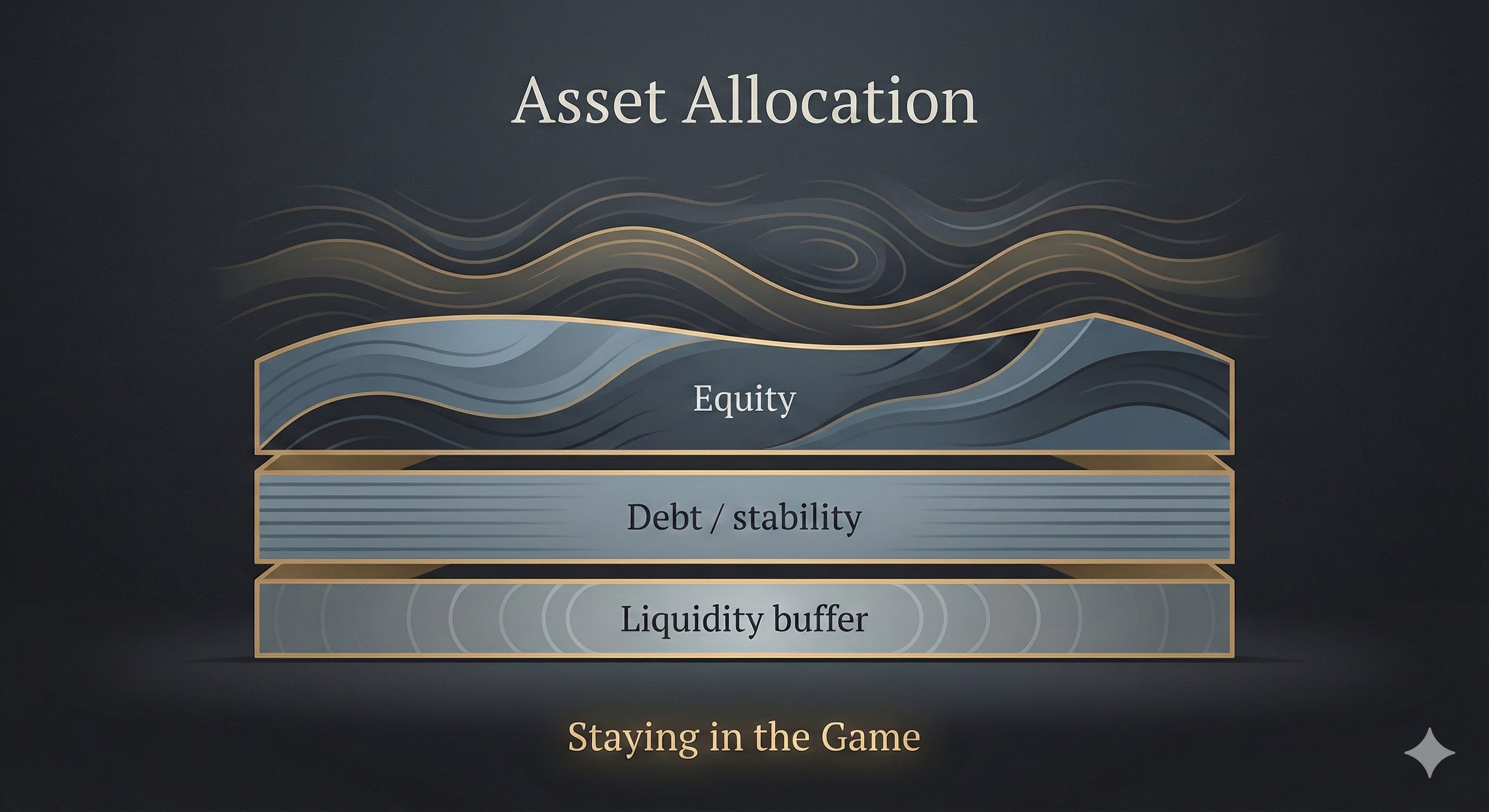
What asset allocation is not
Let’s clear the clutter first.
Asset allocation is not:
about owning “a bit of everything”
about smoothing returns every year
about optimising spreadsheets
about chasing the best-performing asset of the last cycle
If that were all it did, it wouldn’t matter much.
You could simply pick one asset, commit to it, and hope the future behaves kindly.
Hope is not a strategy.
The real problem asset allocation solves
The real problem isn’t volatility.
The real problem is being forced to make decisions at the worst possible time.
Most financial mistakes don’t happen because people chose the wrong asset.
They happen because people were cornered:
forced to sell when prices were down
forced to act because liquidity disappeared
forced to abandon a plan because it became psychologically or financially unbearable
Asset allocation exists to reduce the odds of that happening.
It is a way of structuring your finances so that uncertainty does not push you into self-sabotage.
Start with what you actually have
Before you think about allocation, you need clarity on something more basic.
You need to understand your entire asset base.
How much do you have?
Where is it located?
Do you have direct control over it?
How liquid is it?
These questions are not about optimisation.
They are about constraints.
Asset allocation can only work on what you can actually move, rebalance, or deploy.
Ignoring this reality is how people end up overestimating their flexibility.
The hidden role of real estate
This is where real estate quietly changes the picture.
For most people, real estate is the largest and least liquid part of their net worth.
That matters.
Not because real estate is “bad”, but because:
it cannot be easily or quickly reallocated
it locks up capital for long periods
it reduces the set of decisions you can make when conditions change
When a large portion of net worth is tied up in real estate, the effective portfolio you can actively manage is much smaller than it appears.
That’s why, for the purpose of asset allocation, it is often more practical to treat real estate as a structural constraint, not a dynamic lever.
It shapes your risk capacity - but it is not something you can fluidly move between asset classes the way you can with financial assets.
Asset allocation as constraint management
Viewed properly, asset allocation is not about chasing balance.
It is about managing constraints deliberately instead of discovering them during stress.
You have constraints whether you acknowledge them or not:
liquidity needs
drawdown tolerance
psychological limits
time flexibility
Ignoring these doesn’t make them disappear.
It just guarantees they will surface at the worst possible moment.
Asset allocation is how you bring these constraints into the open before markets force the conversation.
Why portfolio-level thinking changes behaviour
One of the most important shifts asset allocation enables is how you look at your finances.
You stop seeing investments in isolation and start seeing them as parts of a portfolio.
That shift does a few quiet but powerful things:
decisions move from daily or monthly thinking to multi-year thinking
performance is evaluated across asset classes, not individual bets
peaks and troughs across cycles become easier to live with
reactions are driven less by recent price moves and more by structure
Instead of asking:
“What should I buy next?”
You start asking:
“How is my overall portfolio positioned if uncertainty persists longer than expected?”
That’s a fundamentally different question.
Operating at the asset-class level
As this perspective settles in, something else happens.
You stop playing the small game.
You stop worrying about:
which stock will outperform
which fund manager will beat the index
which short-term opportunity you might be missing
Instead, you operate at the asset-class level.
You care less about individual winners and more about:
how different assets behave across cycles
how they interact under stress
how they affect your ability to stay invested
This is not about lowering ambition.
It is about playing a larger game - growing the portfolio as a whole, not chasing isolated wins.
Asset allocation as a filter, not just a choice
One underappreciated benefit of asset allocation is that it tells you what to ignore.
As you get clearer about:
what kinds of risk you are willing to take
what kinds of uncertainty you can live with
what kinds of instruments fit your time horizon
Entire asset classes begin to fall away naturally.
Not because they are inherently “bad”, but because their risk–reward trade-offs don’t resonate with your decision framework.
This is why, for example, instruments like futures and options become easy to avoid.
They require precision about time.
And once time precision becomes a requirement, probability collapses.
The fact that such instruments can occasionally deliver spectacular returns becomes irrelevant if the odds of long-term survival are poor.
Asset allocation makes that exclusion obvious - and comfortable.
Probability, without the math
You don’t need formulas to understand what’s happening here.
Asset allocation is simply answering one question:
What combination of assets allows me to survive the widest range of possible futures without being forced into bad decisions?
Not the best future.
Not the most optimistic one.
The widest range.
That is what increases the likelihood of long-term success under uncertainty.
Asset allocation is not about returns optimisation
This is the subtle but critical shift.
Returns are an outcome.
Asset allocation is a process.
A good asset allocation does not promise higher returns.
It promises something more valuable:
The ability to stay invested long enough for returns to have a chance to materialise.
That may not sound exciting.
But it is why asset allocation works.
Tying it back to decision-making
Under certainty, optimisation makes sense.
Under uncertainty, robustness matters more.
Asset allocation is robustness applied to money.
It is how you avoid building a financial life that only works if the future behaves nicely.
It is how you design a system that continues to function even when the future doesn’t cooperate.
Closing the loop
Across this series:
The first article was about letting go of impossible demands
The second was about choosing constraints deliberately
This one is about structuring your finances so those constraints don’t break you
That is decision-making under uncertainty.
Not predicting the future.
Not eliminating risk.
But building systems that work even when you’re wrong.
Disclaimer
This is educational content, not financial, investment, tax, or legal advice.
Zenca shares perspectives and frameworks to help you think clearly - your decisions are your own.
Please think independently and do your own research.
I write to improve how we think about money.
If this helped you think more clearly about money, you can subscribe to Zenca to receive future essays directly.
Every subscription is a vote for thinking more clearly about money.
And if this resonated, take a few seconds to share it — it might change how someone else thinks about money too.