

The Cost Of Wanting Things Now (1/4) || EMIs, Impatience, And How Easy Payments Change Decisions
The real cost of EMIs isn’t interest - it’s time and optionality.

In India, most big purchases today don’t happen upfront.
They happen monthly.
Phones.
Cars.
Homes.
Not because people can’t afford them - but because they don’t want to wait.
That distinction matters more than we admit.
Because EMIs (equated monthly installments in India) are not really a money problem.
They’re a patience problem.
And impatience is one of the most expensive habits you can have when trying to build wealth.
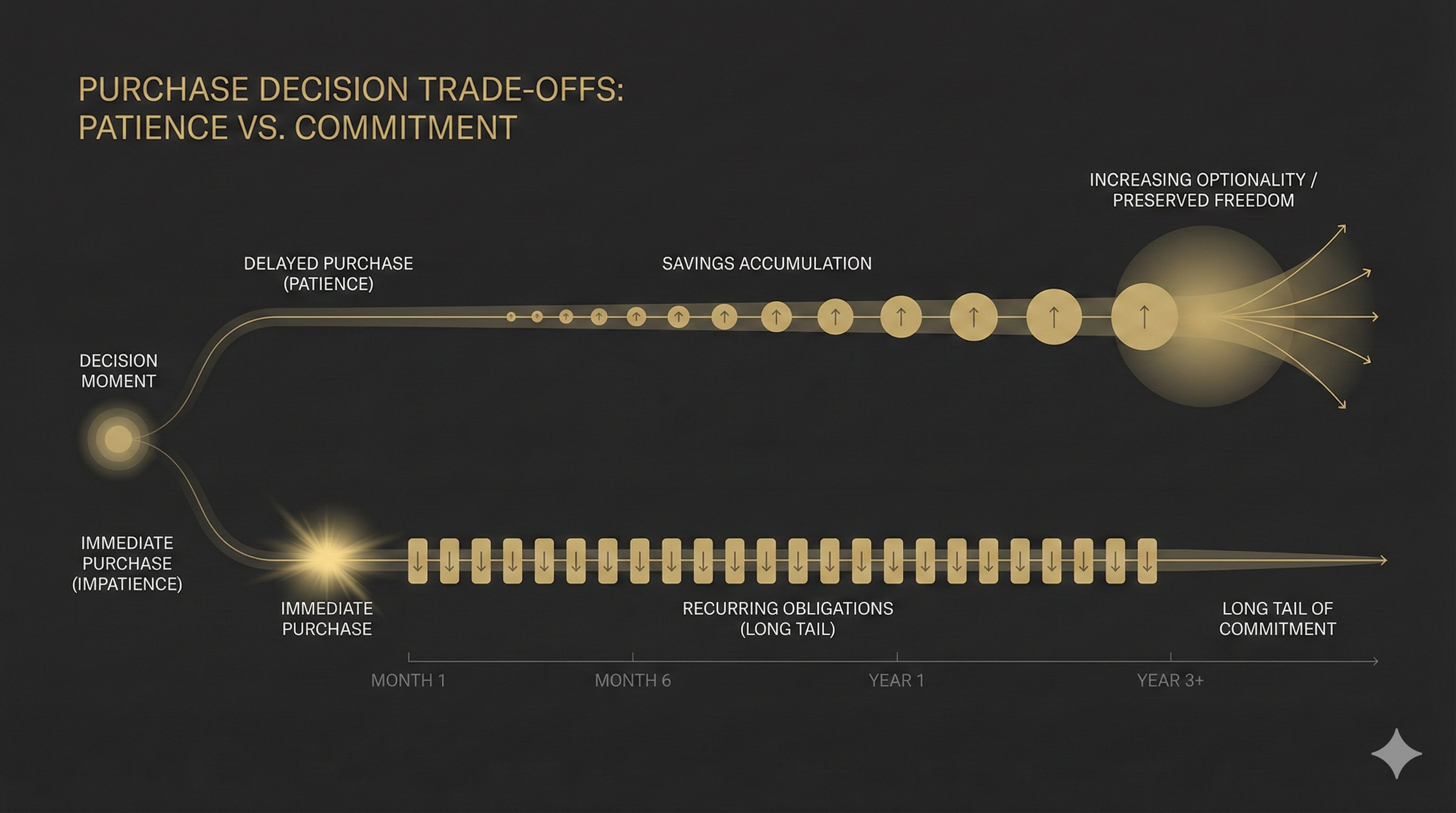
The choice we rarely see clearly
Every financial decision is ultimately a choice between two forces:
Patience - the voice that tells you what you need to hear
Impatience - the voice that tells you exactly what you want to hear
Patience says:
“You don’t need this right now.
You can afford it later — properly.”
Impatience says:
“You deserve this now.
The EMI is small.
Everyone does it.”
EMIs work not because they make things cheaper.
They work because they make waiting unnecessary.
And once waiting disappears, so does restraint.
Why EMIs feel harmless
EMIs are one of the most cleverly designed financial products ever created - not because of interest rates, but because of psychology.
Three things happen the moment a purchase turns into an EMI:
1. The price stops mattering
₹1,00,000 (~$1,000) feels real.
₹4,167 per month (~$41.67 per month) feels abstract.
Your brain doesn’t multiply. It compartmentalizes.
2. Debt disguises itself as a subscription
EMIs start sitting next to Netflix, Spotify, and gym memberships.
Not as obligations - but as “monthly expenses.”
3. Pain is delayed, not removed
You don’t feel the cost today.
You don’t feel it tomorrow.
You only feel it months later - when flexibility disappears.
This is why a lower EMI doesn’t reduce cost.
It reduces awareness.
The math is clear - even if we avoid it
Whether you like it or not, the equation is simple:
EMI × number of months = total outflow
There’s no magic here.
Stretching payments doesn’t make something affordable.
It just spreads the discomfort thin enough for you not to notice it.
But there’s a second cost almost nobody accounts for.
The cost you never see
Every EMI you pay does two things at the same time:
It services past consumption
It prevents future investment
Money sent to an EMI is money that cannot compound.
So the real cost of impatience is not just interest.
It’s opportunity cost.
And opportunity cost is brutal precisely because it never shows up on a statement.
No alert.
No reminder.
No regret - until years later.
Impatience compounds too - just in the wrong direction
We talk a lot about compounding when it comes to investing.
But compounding works on behavior as well.
Small acts of patience compound into financial flexibility
Small acts of impatience compound into financial rigidity
One EMI leads to another.
One “manageable” monthly payment becomes many.
Suddenly, your future income is already spoken for.
Not by emergencies.
Not by investments.
But by past wants.
This isn’t about never using EMIs
Let’s be clear.
Debt isn’t evil.
EMIs aren’t inherently bad.
Some purchases are too large to pay upfront.
Some cash flows justify spreading payments.
The problem isn’t the EMI.
The problem is letting impatience make the decision for you.
When EMIs become the default instead of the exception, wealth quietly stops forming.
The real question to ask yourself
Before any EMI, the question isn’t:
“Can I afford the monthly payment?”
It’s:
“Am I buying this because it fits my long-term life -
or because I don’t want to wait?”
Because wealth isn’t built by clever products.
It’s built by repeatedly choosing patience over convenience - long enough for compounding to do its work.
And impatience?
It always collects its fee.
Just not upfront.
Next: We’ll put real numbers to this - and show how EMIs quietly steal from future investments, even when they look ‘manageable’ today.
Disclaimer
This is educational content, not financial, investment, tax, or legal advice.
Zenca shares perspectives and frameworks to help you think clearly - your decisions are your own.
Please think independently and do your own research.
I write to improve how we think about money.
If this helped you think more clearly about money, you can subscribe to Zenca to receive future essays directly.
Every subscription is a vote for thinking more clearly about money.
And if this resonated, take a few seconds to share it — it might change how someone else thinks about money too.