

How Asymmetric Bets Actually Play Out
Why they create disproportionate wealth - and how the price of entry shifts over time.

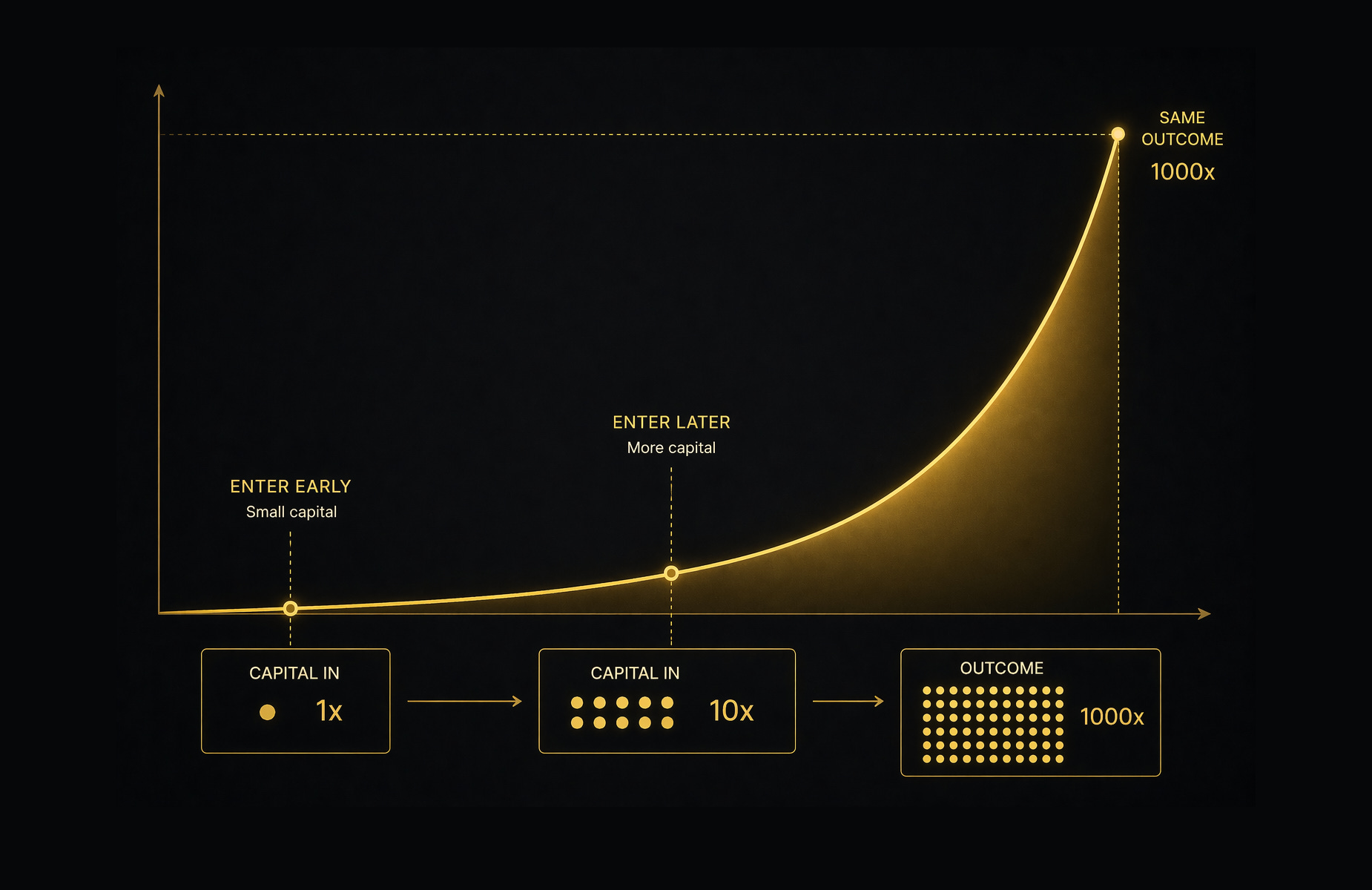
Asymmetric bets are one of the few ways to grow money disproportionately.
They are situations where the downside is limited, but the upside can be meaningfully large.
The downside is capped and manageable.
The upside is large and open-ended.
That upside doesn’t come from a single event.
It comes from multiple things going right over time - often in ways that aren’t obvious at the start.
If they work, they don’t just generate returns - they change outcomes.
This is why so many stories of wealth creation trace back to them.
A small investment in a stock that becomes life-changing decades later.
A piece of land bought when no one cared about it, that later becomes central.
These outcomes look obvious in hindsight.
But they don’t start that way.
Part of what makes these outcomes look dramatic is also the system itself expanding.
When the money supply grows over decades, nominal values stretch with it.
But that alone doesn’t explain the results.
They came from doing something most people around them weren’t doing.
Most people didn’t act.
And those who could have, didn’t have the conviction.
We also mostly hear about the outcomes that worked.
The ones where the asymmetry didn’t play out rarely get talked about.
Which makes these results look more common - and more predictable - than they actually are.
Every asymmetric bet follows a similar pattern.
At the beginning, the biggest barrier isn’t capital.
It’s conviction.
To even participate, you have to believe in something that looks improbable - sometimes even absurd.
That conviction doesn’t come from guessing.
It comes from doing the work.
In investing, the edge is often in reading the room early -
seeing what is starting to work for a few,
doing your own due diligence,
and getting in before everyone else catches on.
That’s the difference between an asymmetric bet and a blind bet.
An asymmetric bet is built on research and conviction.
A blind bet is just participation without either.
Many people participate.
But very few do so with real conviction.
The bar isn’t capital.
It’s conviction.
And for those who cross that bar,
conviction does most of the work.
Even small amounts, when backed by strong conviction and enough time, can become meaningful — because the asymmetry has room to play out.
That combination does the heavy lifting.
Over time, this changes.
As more people begin to recognize the opportunity, the conviction required to invest comes down.
The idea becomes more visible.
More understood.
More accepted.
Which means more people are willing to participate.
And when that happens, the price of entry shifts.
From conviction… to capital.
In investing, competition doesn’t show up as better products —
it shows up as higher prices.
As more capital flows in, the opportunity gets priced in.
Prices rise.
Future returns compress.
And as that happens, the asymmetry starts reducing.
The asymmetry may still exist.
But your share of it depends on what you bring to the table.
If you didn’t pay the price through extreme conviction early on,
you have to pay through higher capital.
And through time.
Because time doesn’t compress.
In every asymmetric bet, the payoff is still tied to a long horizon — that part of the equation doesn’t change.
So the equation is always the same:
How much you put in.
How strongly you believe.
How long you stay.
What changes is which of these does the heavy lifting.
Early on, it’s conviction.
Later, it’s capital.
Time is always there.
Same asymmetric bet.
Same three variables.
Different price of entry.And no free variables.
Disclaimer
This is educational content, not financial, investment, tax, or legal advice.
Zenca shares perspectives and frameworks to help you think clearly - your decisions are your own.
Please think independently and do your own research.
I write to improve how we think about money.
If this helped you think more clearly, you can subscribe to Zenca to receive future essays directly.
Every subscription is a vote for thinking more clearly about money.
And if this resonated, take a few seconds to share it — it might change how someone else thinks about money too.