

Inflation Reframed
How inflation is measured, experienced, and driven.

Inflation is one of those words everyone uses and few agree on.
For some, it means prices going up.
For others, it means wages falling behind.
For policymakers, it’s a number.
For households, it’s a feeling.
This series was written to step back from the noise and ask a simpler set of questions:
What is inflation, really?
Why does it feel different from the number we’re shown?
Why does it hit some people harder than others?
And at the level of an entire country, what actually drives it?
The five essays below approach inflation from the ground up - starting with lived experience, moving through measurement and distribution, and ending at the system level.
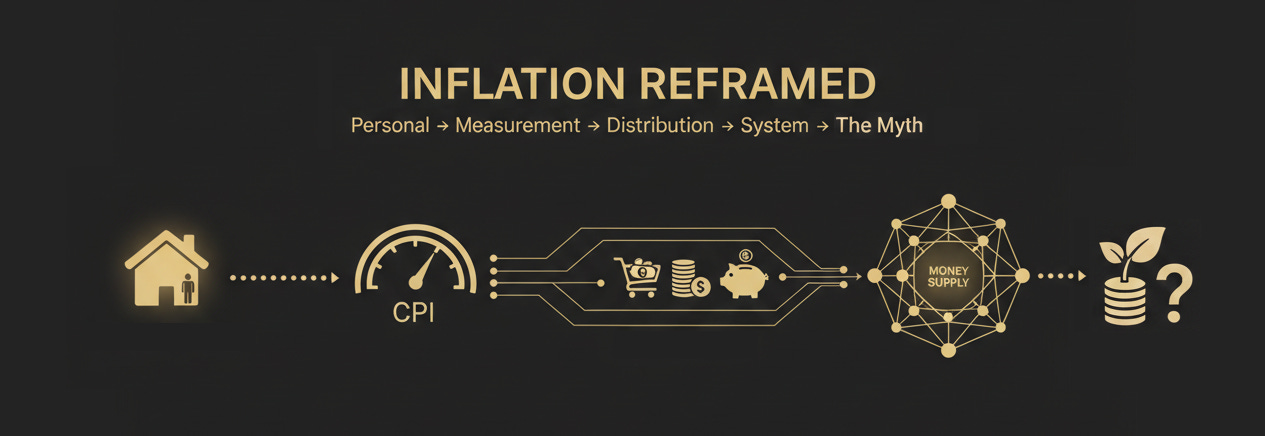
How to Read This Series
Each post stands on its own, but they are designed to be read in order.
The sequence matters because inflation is often misunderstood not due to bad intentions, but because different levels of analysis are mixed together. This series separates them.
Personal experience comes first
Measurement comes second
Distribution comes third
Systemic forces come last
No ideology.
No prescriptions.
Just mechanics.
The Series
#1 - Inflation Isn’t Prices Going Up. It’s Money Buying Less.
Prices are the symptom; purchasing power is the disease.
This essay reframes inflation at the most basic level. Instead of starting with price tags, it starts with the unit of account itself - and shows why prices are a downstream effect, not the cause.
#2 - Why the Inflation Number Feels Wrong (Even When It Isn’t)
CPI measures how inflation shows up - not why it exists.
Here we look at what inflation indices like CPI are designed to do, what they do well, and why they often feel disconnected from lived experience. The issue isn’t deception - it’s scope.
#3 - Why Inflation Hits You Differently Than Everyone Else
Inflation is experienced personally, not averaged nationally.
Inflation doesn’t arrive evenly. This post explains why averages hide distribution, why marginal bidders set prices, and why inequality amplifies inflation in certain markets without needing bad actors.
#4 - Systemic Inflation: The One Measure That Explains Everything
At the country level, inflation begins with money itself.
Zooming out, this essay looks at inflation from the nation-state perspective. It introduces money supply as a measure of systemic pressure and explains why prices can pause, rotate, or lag - while purchasing power dilution persists.
#5 - The Myth of “Healthy Inflation”
Growth creates abundance; inflation redistributes claims on it.
The final piece challenges the idea that inflation is a natural or necessary feature of growth. It separates productivity from money expansion, explains why deflation isn’t inherently harmful, and closes the loop on the series.
What This Series Is - and Is Not
This series is:
descriptive, not prescriptive
mechanical, not moral
explanatory, not political
It does not argue for a particular policy.
It does not claim inflation is always intentional.
It does not suggest easy solutions.
Its goal is simpler:
to make inflation easier to understand before trying to judge it.
Where This Leads Next
Once inflation is understood as a system-level outcome rather than a price-level mystery, a different question naturally follows:
If inflation is costly and persistent, why does it keep being chosen?
That question isn’t about prices or statistics.
It’s about incentives and constraints.
We’ll come back to that.
Disclaimer
This is educational content, not financial, investment, tax, or legal advice.
Zenca shares perspectives and frameworks to help you think clearly - your decisions are your own.
Please think independently and do your own research.
I write to improve how we think about money.
If this helped you think more clearly about money, you can subscribe to Zenca to receive future essays directly.
Every subscription is a vote for thinking more clearly about money.
And if this resonated, take a few seconds to share it — it might change how someone else thinks about money too.