

Inflation Reframed (1/5) || Inflation Isn't Prices Going Up. It's Money Buying Less.
Prices are the symptom; purchasing power is the disease.

Most of us experience inflation the same way.
Milk costs more.
Rent feels heavier.
A meal out that used to be “normal” now needs a second thought.
So we say: prices are going up.
That’s not wrong.
But it’s incomplete.
Because prices are not the thing that changes first.
Two Ways to Look at Inflation
There are two ways to describe the same reality:
Stuff is getting more expensive
My money is buying less stuff
The first focuses on the object.
The second focuses on the unit of account.
And once you switch lenses, inflation starts to make a lot more sense.
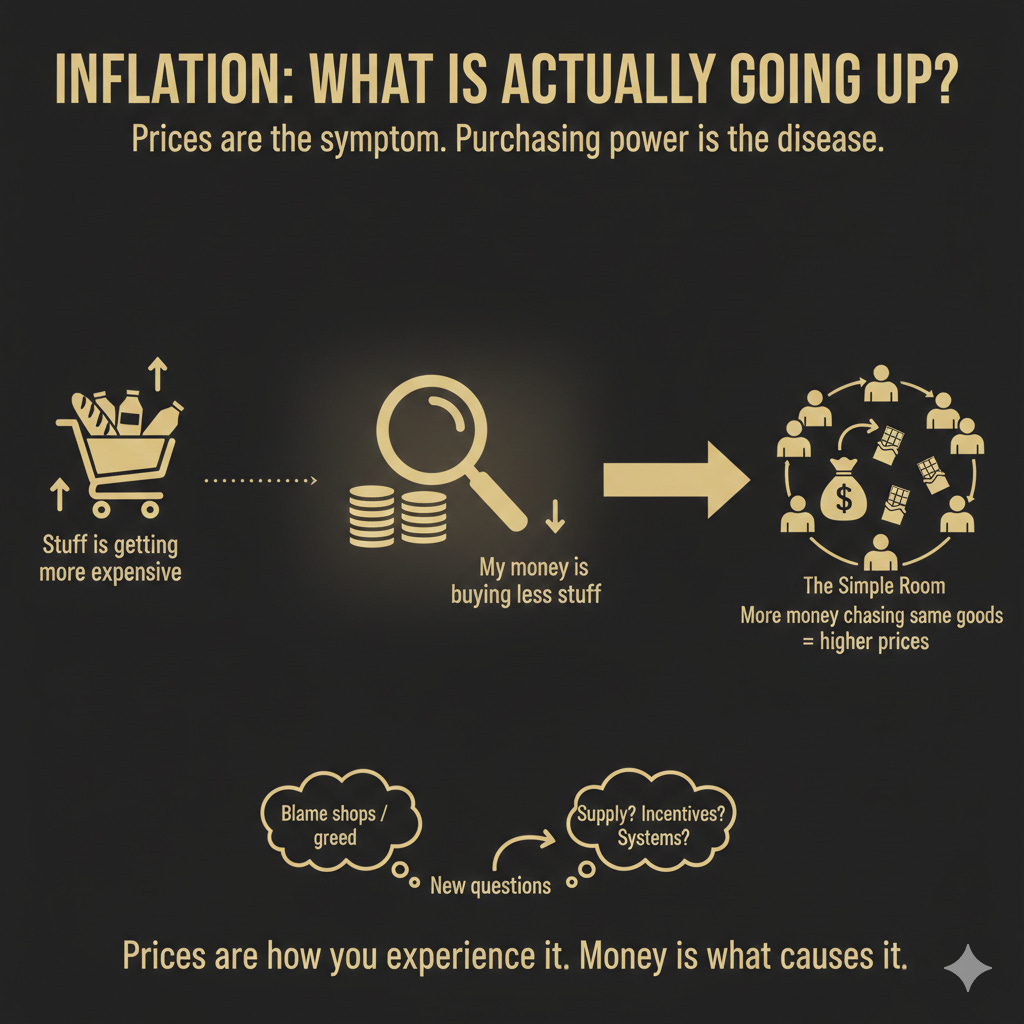
A Simple Room
Imagine a closed room.
There are 10 people in the room
Each person wants 1 chocolate
Only 5 chocolates exist
Everyone is free to bid however much they want
No corporations.
No governments.
No printing presses.
Just people, money, and scarcity.
Day 1: Balance
Everyone in the room has ₹100 (~$1).
Five people really want a chocolate.
They bid ₹100 (~$1) each.
The price settles at ₹100 (~$1).
Nothing strange happens.
Money and goods are in balance.
Day 2: More Money, Same Goods
Now imagine something changes.
Everyone starts the day with ₹150 (~$1.50) instead of ₹100 (~$1).
Still 10 people.
Still 5 chocolates.
What happens?
The bidding starts higher.
The chocolates now sell for ₹150 (~$1.50).
No one became greedier.
No seller changed behaviour.
The only thing that changed was the amount of money competing for the same goods.
Prices rose because money expanded.
What Actually Happened?
It’s tempting to say:
“The price of chocolate went up.”
But a more accurate description is:
The value of ₹1 (~$0.01) went down.
Chocolate didn’t change.
People didn’t change.
Scarcity didn’t change.
The unit used to measure value did.
Inflation Is a Bidding Phenomenon
This is the part most people miss.
Prices are not set in isolation.
They are discovered through competition.
When more money enters the system:
Buyers can bid more
Sellers don’t need to do anything differently
Prices adjust automatically
Inflation doesn’t require:
Greed
Bad intentions
Economic overheating
It only requires more money chasing the same set of goods.
Why This Framing Matters
If you think inflation is about prices:
You look for villains
You blame shops, companies, or middlemen
If you think inflation is about money:
You start asking different questions
About supply, incentives, and systems
Both descriptions point to the same outcome.
But only one explains why it keeps happening across time and countries.
One Last Twist
In the room example, everyone had the same amount of money.
In the real world, they don’t.
And that turns out to matter a lot.
Because prices are not set by the average buyer.
They are set by the marginal buyer who can bid the most.
We’ll come back to this.
The Takeaway
Inflation is not just about prices going up.
It is about money losing purchasing power.
Prices are how you experience it.
Money is what causes it.
Once you see that distinction, everything else - CPI, inequality, asset prices, even policy debates - becomes much easier to understand.
Next: if inflation is real, why does the official number so often feel wrong?
Disclaimer
This is educational content, not financial, investment, tax, or legal advice.
Zenca shares perspectives and frameworks to help you think clearly - your decisions are your own.
Please think independently and do your own research.
I write to improve how we think about money.
If this helped you think more clearly about money, you can subscribe to Zenca to receive future essays directly.
Every subscription is a vote for thinking more clearly about money.
And if this resonated, take a few seconds to share it — it might change how someone else thinks about money too.