

Inflation Reframed (2/5) || Why the Inflation Number Feels Wrong (Even When It Isn’t)
CPI measures how inflation shows up - not why it exists.

After inflation shows up in daily life, something else usually follows.
Confusion.
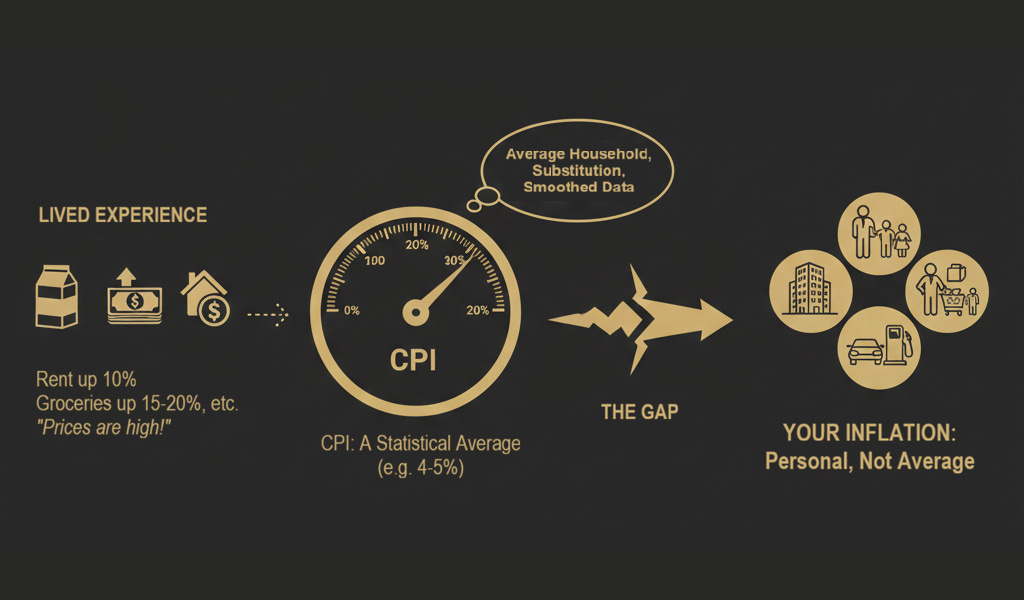
You hear that inflation is 4–5%.
But your rent is up 10%.
Your grocery bill feels 15–20% higher.
School fees, healthcare, insurance - none of it seems to match the number.
So a natural conclusion forms:
The inflation number must be wrong.
That conclusion is understandable.
But it isn’t quite accurate.
The problem isn’t that the number is fake.
It’s that the number is answering a different question.
What CPI Is Actually Trying to Measure
The most commonly cited inflation number is CPI - the Consumer Price Index.
At its core, CPI is:
A statistical average
Based on a basket of goods and services
Weighted by how much an “average” household is assumed to consume
That basket includes things like:
Food
Fuel
Housing-related costs
Clothing
Transportation
Some services
Each item has a weight.
Each weight is updated periodically.
Prices are sampled, averaged, smoothed.
From a statistical standpoint, this is not nonsense.
It is a reasonable attempt to summarize a very complex reality.
But that also explains why it often feels disconnected from your life.
Why Your Inflation Rarely Matches CPI
There are three structural reasons CPI rarely feels right at the individual level.
1. CPI Is an Average - You Are Not
CPI describes the experience of a hypothetical average household.
You don’t live in that household.
Your spending depends on:
Your city
Your stage of life
Whether you rent or own
Whether you have children
Whether you rely on services or assets
Two people in the same country can experience wildly different inflation - and both can be correct.
2. CPI Allows Substitution
If the price of one item rises sharply, CPI assumes people substitute toward cheaper alternatives.
Chicken gets expensive → people buy more vegetables.
Brand A rises → people switch to Brand B.
This makes sense statistically.
But it creates a subtle gap emotionally.
CPI asks:
Can you maintain a similar standard of living?
People often feel:
I am being forced to downgrade.
That difference matters.
3. CPI Is Smoothed Over Time
Prices don’t move evenly.
Some jump suddenly.
Some lag.
Some reverse.
CPI smooths these movements to avoid overreacting to short-term noise.
Your life does not.
You experience inflation at the moment of payment, not as a rolling average.
What CPI Does Well - and What It Doesn’t
This is the key distinction.
CPI does a decent job at measuring:
How consumer prices change on average
Over time
For a broad population
CPI does not measure:
Loss of purchasing power for savers
Asset price inflation
Education, healthcare, or housing stress for specific groups
The erosion of money itself
And crucially, CPI does not explain why inflation exists in the first place.
It only describes where it shows up.
Why Governments Rely on CPI
This isn’t about deception.
CPI is useful because:
It is observable
It is repeatable
It is politically and administratively manageable
Governments need a number to:
Adjust pensions
Index wages
Set policy targets
A broad consumer index is practical.
But practicality is not the same as completeness.
Connecting Back to Inflation Itself
In the previous post, we reframed inflation as:
Money buying less.
CPI does not measure that directly.
It measures one downstream effect of that process - consumer prices - filtered through averages, weights, and assumptions.
That’s why CPI can be:
Statistically correct
Conceptually honest
And still feel wrong
All at the same time.
The Takeaway
CPI is not lying to you.
It’s just not talking about you.
It answers:
How are consumer prices changing on average?
Most people are really asking:
Why does my money feel weaker?
Those are related questions - but they are not the same one.
To understand why inflation feels so uneven, we need to look beyond averages and into how inflation distributes itself across people, assets, and income levels.
That’s next.
Disclaimer
This is educational content, not financial, investment, tax, or legal advice.
Zenca shares perspectives and frameworks to help you think clearly - your decisions are your own.
Please think independently and do your own research.
I write to improve how we think about money.
If this helped you think more clearly about money, you can subscribe to Zenca to receive future essays directly.
Every subscription is a vote for thinking more clearly about money.
And if this resonated, take a few seconds to share it — it might change how someone else thinks about money too.