

Inflation Reframed (3/5) || Why Inflation Hits You Differently Than Everyone Else
Inflation is experienced personally, not averaged nationally.

By now, two things should be clear.
First, inflation is not just prices going up.
It’s money buying less.
Second, the inflation number you hear is an average - not a mirror.
Once you accept both, the next question becomes unavoidable:
If inflation is real, why does it feel very real to some people and almost invisible to others?
The answer is simple, uncomfortable, and often misunderstood.
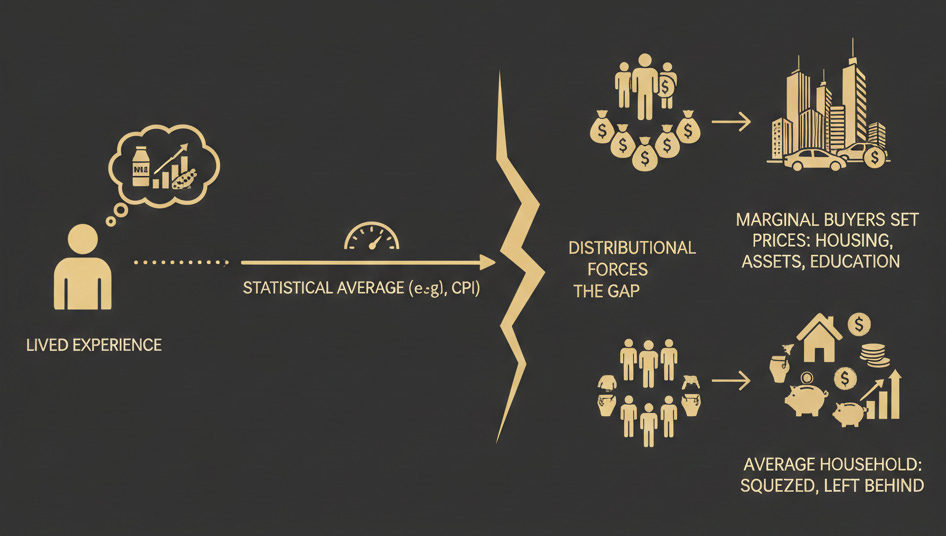
Inflation Is Not Evenly Distributed
Inflation does not arrive everywhere at once.
It doesn’t hit all prices together.
It doesn’t hit all people equally.
And it doesn’t move in a smooth, predictable line.
Instead, inflation:
enters specific pockets first
flows through specific markets
and is felt based on where you sit in the economy
That’s not a flaw in the system.
That’s how the system works.
Back to the Room
Let’s return briefly to the room with chocolates.
10 people
5 chocolates
Everyone wants one
Prices are set by bidding
Now imagine something changes.
Not everyone gets the same amount of money.
Some people have more.
Some people have much more.
What happens?
The price of chocolate is no longer determined by the average amount of money in the room.
It is determined by the person willing and able to bid the most.
That person becomes the marginal buyer.
And the marginal buyer sets the price.
Averages Don’t Set Prices. Margins Do.
This is the key insight.
Prices are not set by:
the median income
the average household
the “typical” consumer
They are set at the margin - by:
the highest effective bidder
in markets where supply is constrained
This is why:
housing prices can surge even when median incomes stagnate
asset prices can rise while consumer inflation looks “contained”
some people feel crushed while others barely notice
Inflation follows purchasing power, not population.
Why Inequality Amplifies Certain Kinds of Inflation
This is not a moral argument.
It’s a mechanical one.
When money and income are unevenly distributed:
prices in scarce markets move toward the top end
not toward the average
This effect is strongest when:
supply is limited
goods are non-substitutable
and buyers compete directly
Think:
housing in dense cities
education
healthcare
financial assets
premium services
In these markets, even a small group with deep pockets can pull prices higher for everyone else.
That doesn’t require malicious intent.
It requires competition over scarcity.
Why Asset Inflation Feels Invisible - Until It Doesn’t
One reason inflation debates get stuck is because people talk past each other.
Some are talking about:
food
fuel
rent
daily expenses
Others are living in a world where inflation shows up first in:
real estate
stocks
private equity
collectibles
Both are describing real inflation.
They’re just seeing it at different transmission points.
Asset inflation often:
benefits those who already own assets
hurts those trying to buy them later
Which means:
by the time inflation shows up in daily life
it has often already reshaped balance sheets
Your Personal Inflation Rate Is a Function of Your Life
Whether inflation hurts you depends on:
what you consume
what you own
how flexible your spending is
whether your income adjusts quickly
whether your savings compound or erode
A renter experiences inflation differently from a homeowner.
A young family differently from a retiree.
A saver differently from a borrower.
All can be true at the same time.
That’s why arguments about inflation often feel like arguments about reality itself.
They are.
Why “Low Inflation” Can Coexist with Widespread Pain
This is where the disconnect becomes most dangerous.
A country can report:
moderate CPI inflation
stable averages
manageable numbers
While large segments of the population feel:
squeezed
left behind
permanently outbid
Not because the data is fake -
but because the pain is concentrated, not averaged.
Inflation doesn’t need to be high everywhere to be destructive somewhere.
The Takeaway
Inflation is not a uniform tax.
It is a distributional force.
It moves through the economy along lines of:
income
wealth
access
timing
Which means:
averages will always understate lived experience
disagreements about inflation are often disagreements about position
To really understand inflation, we need to stop asking:
What is the number?
And start asking:
Who feels it first - and why?
To answer that at the level of an entire country, we need to zoom out one last time.
Because beneath all these uneven experiences lies a single systemic pressure.
That’s next.
Disclaimer
This is educational content, not financial, investment, tax, or legal advice.
Zenca shares perspectives and frameworks to help you think clearly - your decisions are your own.
Please think independently and do your own research.
I write to improve how we think about money.
If this helped you think more clearly about money, you can subscribe to Zenca to receive future essays directly.
Every subscription is a vote for thinking more clearly about money.
And if this resonated, take a few seconds to share it — it might change how someone else thinks about money too.