

Inflation Reframed (5/5) || The Myth of “Healthy Inflation”
Growth creates abundance; inflation redistributes claims on it.

By this point in the series, a pattern should be visible.
Inflation is not just prices going up.
It’s money buying less.
It doesn’t hit everyone equally.
And at the system level, it begins with the expansion of money itself.
Yet despite all this, one idea remains remarkably persistent:
Inflation is normal. Inflation is healthy. Inflation is a sign of a growing economy.
That belief is widespread.
It is also deeply confused.
Where the Idea of “Healthy Inflation” Comes From
The argument usually sounds something like this:
Growing economies have rising demand
Rising demand leads to higher prices
Therefore, some inflation is natural - even desirable
At first glance, this feels intuitive.
But it mixes together two very different phenomena:
real growth
monetary expansion
They are not the same thing.
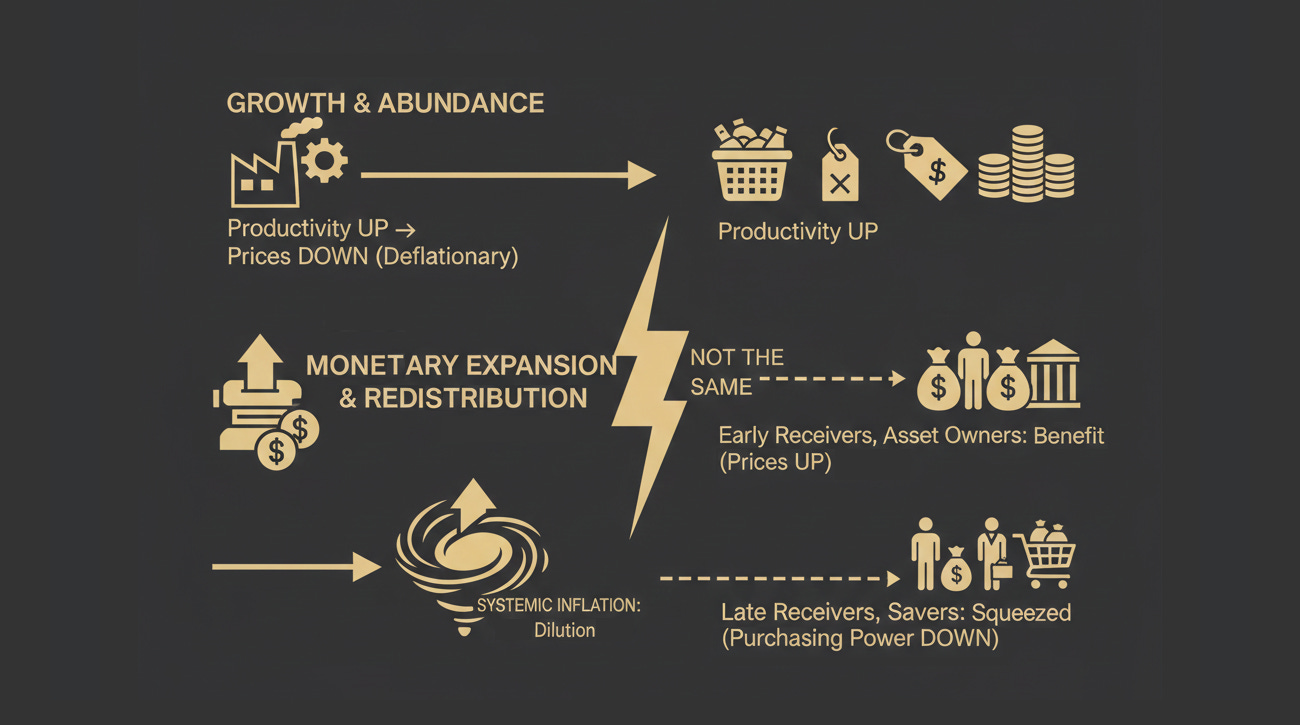
Growth Does Not Require Inflation
Economic growth means:
producing more
producing better
producing more efficiently
When productivity rises, one very natural outcome is:
things become cheaper.
This is not theoretical.
It happens constantly.
Think about:
computing power
data storage
consumer electronics
telecommunications
These sectors experienced extraordinary growth - and persistent deflation.
Prices fell because:
productivity improved
supply expanded
innovation outpaced monetary effects
Growth created abundance.
Prices reflected that abundance.
No harm done.
As investor and analyst Lyn Alden has often pointed out, technology and productivity are naturally deflationary forces.
They allow societies to produce more goods and services with fewer inputs, which should, over time, make things cheaper.
In a purely productivity-driven system, rising prosperity would show up as falling prices or stable prices, not persistent inflation.
What interrupts this process is the steady expansion of the money supply.
When money grows faster than productivity, the deflationary force of technology is offset - and often overwhelmed.
The result is not obvious deflation, but the mild, persistent inflation many people come to see as “normal.”
In that sense, much of modern inflation is not a sign of growth, but of money expansion outrunning technological progress.
Deflation Is Not a Dirty Word
Deflation simply means:
the same money buys more.
In productivity-driven contexts, that is not a failure.
It is a feature.
Historically, long periods of growth have coexisted with:
stable prices
or gently falling prices
The idea that prices must rise for an economy to function is not an economic law.
It is a much newer assumption.
So Why Is Deflation Feared?
The fear of deflation does not come from consumers.
It comes from debt-heavy systems.
When prices fall:
debts become harder to service
leverage becomes riskier
financial systems become fragile
In such systems, stable or falling prices are uncomfortable.
Rising prices are relieving.
This does not mean inflation is inherently good.
It means inflation is convenient for certain structures.
That distinction matters.
Inflation Is Often Justified After the Fact
Because inflation redistributes purchasing power, it is often reframed as:
necessary
natural
beneficial
But this framing usually comes after the monetary expansion has already occurred.
Inflation is rarely introduced as:
“We are diluting the unit of account.”
It is introduced as:
“Supporting growth.”
“Avoiding deflation.”
“Maintaining stability.”
The narrative follows the mechanism - not the other way around.
Separating Two Questions That Are Often Confused
It helps to separate these questions clearly:
Is economic growth good?
Yes.Does growth require prices to rise?
No.Does inflation help certain systems function?
Sometimes.Is inflation therefore healthy by default?
No.
Inflation is not a vitamin.
It is not nourishment.
It is a redistribution mechanism.
Why the Myth Persists
The myth of “healthy inflation” persists because:
its costs are diffuse
its benefits are concentrated
its mechanics are poorly understood
Most people experience inflation as a fact of life, not a choice.
Most discussions stop at prices, not money.
So the story survives.
What This Series Was Trying to Do
This series wasn’t about:
predicting inflation
assigning blame
or prescribing solutions
It was about changing the frame.
From:
prices → money
averages → distribution
narratives → mechanics
Once you see inflation this way, many debates soften.
Not because they disappear —
but because you’re no longer arguing about symptoms.
The Final Takeaway
Inflation is not inherently good or bad.
But it is also not natural law.
It is a consequence of:
how money is managed
how systems are structured
and who absorbs the adjustment
Growth creates abundance.
Inflation reallocates claims on that abundance.
Confusing the two is how the myth survives.
Disclaimer
This is educational content, not financial, investment, tax, or legal advice.
Zenca shares perspectives and frameworks to help you think clearly - your decisions are your own.
Please think independently and do your own research.
I write to improve how we think about money.
If this helped you think more clearly about money, you can subscribe to Zenca to receive future essays directly.
Every subscription is a vote for thinking more clearly about money.
And if this resonated, take a few seconds to share it — it might change how someone else thinks about money too.