

Investment Behavior (2/3) || The Hidden Difference Between Liquid And Illiquid Investments
Some investments tell us too much. Others tell us too little. Both can quietly distort the way we understand risk.

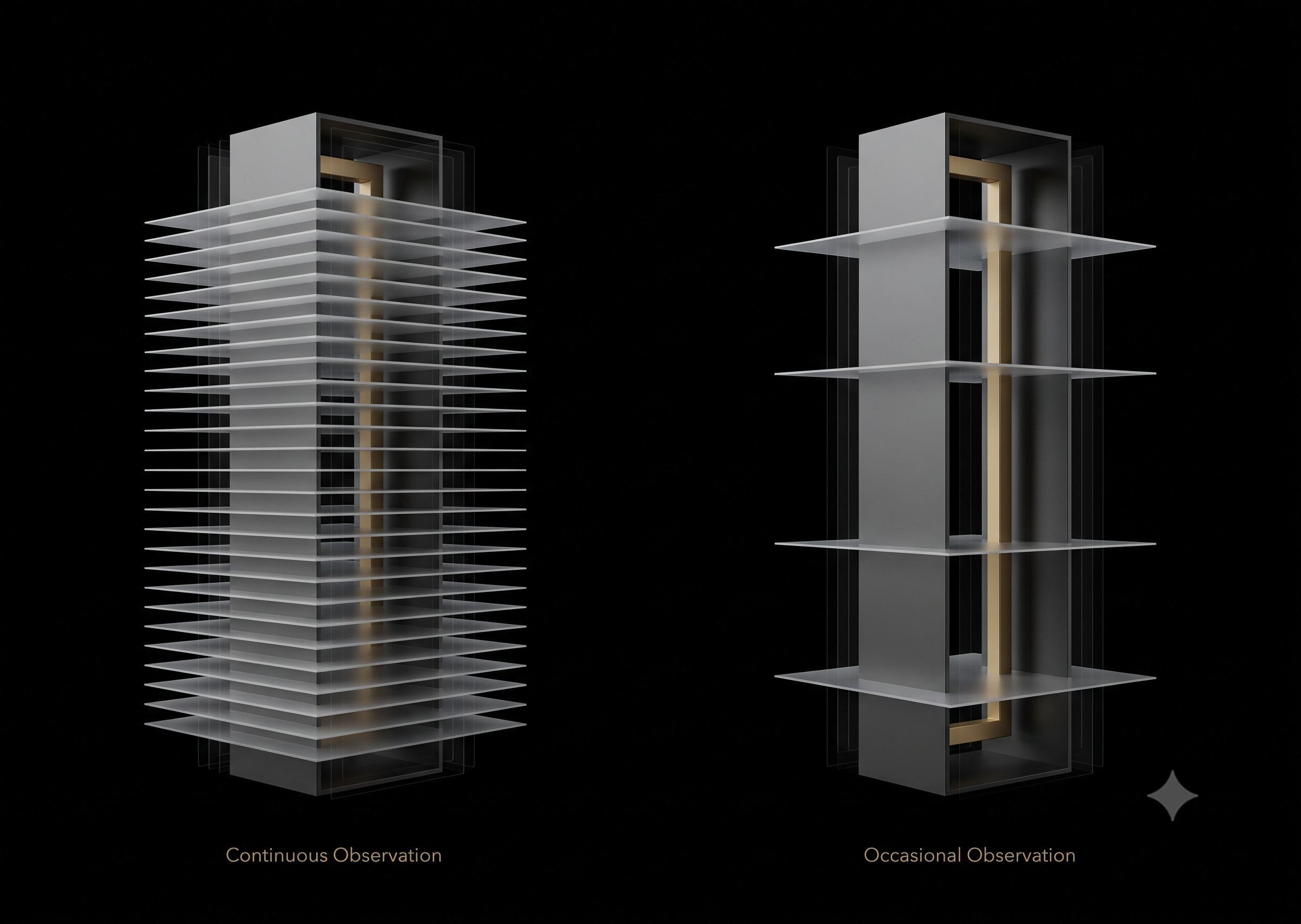
Imagine two people discussing their investments over dinner.
One owns a diversified portfolio of listed shares. The other owns a rental property.
The stock investor casually mentions that their portfolio fell three per cent that week.
The property owner smiles.
“My property hasn’t moved at all.”
It sounds reassuring.
One investment appears volatile.
The other appears stable.
But there is a subtle question hiding beneath that conversation.
Did one asset actually change more than the other?
Or did one simply reveal more of its changes?
What We Can See Shapes What We Believe
Human beings naturally trust what they can observe.
If something changes visibly, we assume something important has happened.
If it appears unchanged, we often assume it has remained stable.
This works remarkably well in many parts of life.
A cracked wall deserves attention.
A shrinking bank balance tells us something useful.
A child who develops a fever needs care.
Visible change often reflects real change.
Investments, however, are different.
Some investments reveal their changing value almost continuously.
Others reveal very little at all.
And I increasingly think that this difference shapes investor behavior far more than most of us realise.
The Illusion Of Constant Change
Consider a broadly diversified equity fund.
Thousands of investors buy and sell its underlying holdings every day.
Every trade creates another data point.
Every data point contributes to another market price.
Open an investment app and you can see exactly what the market was willing to pay a few seconds ago.
This feels extraordinarily informative.
But it also creates a subtle illusion.
Because a price is available every moment, it becomes tempting to believe that the investment itself is changing every moment.
In reality, the underlying businesses may have changed very little.
Their employees still went to work.
Their customers still bought products.
Factories still produced goods.
Software still served users.
The market price moved.
The businesses themselves may hardly have.
Price is valuable information.
But it is not the same thing as the investment itself.
Those two ideas quietly drift apart surprisingly often.
The Illusion Of Stability
Now consider a property.
Its market value is rarely updated.
Perhaps the owner obtains an estimate once a year.
Perhaps only when they decide to sell.
For months, or even years, the reported value may appear unchanged.
This feels comforting.
Nothing seems to be happening.
Yet almost everything that determines the property’s value continues changing.
The neighbourhood evolves.
Interest rates move.
Demand changes.
Maintenance is deferred or completed.
Rental yields strengthen or weaken.
Potential buyers become more or less willing to pay.
The economics continue moving even while the valuation appears perfectly still.
The absence of visible movement does not necessarily mean the absence of change.
It often means the absence of measurement.
Neither Picture Is Complete
This creates an interesting tension.
Liquid investments often look more volatile than they really are.
Illiquid investments often look more stable than they really are.
Neither impression is entirely accurate.
One exposes us to almost every fluctuation.
The other hides many of them.
Both distort reality in different directions.
Perhaps this is why conversations about risk sometimes become confusing.
People compare what they can see.
Not necessarily what actually exists.
Information Changes Behavior
The interesting thing is that information rarely remains passive.
It changes the person receiving it.
Suppose your portfolio updates every second. Every fluctuation becomes another opportunity to feel optimistic, worried or uncertain. Even if you never trade, the experience of owning the investment changes.
You begin living alongside its movements.
Now imagine owning an illiquid investment. Months pass without any obvious change in value. The experience is very different.
The investment fades into the background of daily life.
One investment repeatedly asks for attention.
The other quietly disappears from view.
Neither experience is necessarily better.
They simply create different psychological challenges.
Liquidity Creates Freedom
Liquidity is generally described as one of the great advantages of financial markets.
And for good reason.
Liquid investments can usually be bought and sold quickly.
They make rebalancing easier.
They provide access to capital when circumstances change.
They allow investors to adjust portfolios gradually rather than all at once.
These are genuine advantages.
But liquidity also creates something less obvious.
It creates the constant opportunity to change your mind.
Every market hour presents another invitation.
Sell.
Buy.
Reduce.
Increase.
Wait.
The option is always there.
The remarkable thing is that simply possessing that option changes behavior.
Many investors begin reconsidering decisions far more often than the underlying investment actually deserves.
Liquidity gives us freedom.
It also gives us temptation.
Illiquidity Creates Patience
Illiquid assets often create the opposite experience.
Selling a business may take months.
Selling a property may take weeks or longer.
Private investments sometimes cannot be exited at all until a future event occurs.
This can feel frustrating.
But it also creates a kind of enforced patience.
Owners often spend less time reacting to prices because there are few prices to react to.
Instead, attention shifts towards something more fundamental.
Cash flow.
Customers.
Occupancy.
Maintenance.
Operations.
The underlying asset.
That is one of the genuine strengths of illiquid investing.
It naturally directs attention away from market fluctuations.
Yet there is a danger here too.
Forced patience can easily be mistaken for genuine patience. Someone who cannot easily sell an investment may appear extraordinarily disciplined.
But discipline only really exists when a meaningful alternative is available.
Patience is not simply holding.
It is choosing to continue holding when leaving remains possible.
When Prices Become A Distraction
Modern investing has become remarkably good at delivering information.
Real-time prices.
Live charts.
Breaking news.
Notifications.
Predictions.
Commentary.
Opinions.
None of these are inherently bad. Many are genuinely useful.
But they create an environment in which prices become the easiest part of investing to observe.
The problem is that the easiest thing to observe is not always the most important thing to understand.
A falling share price may deserve less attention than a deteriorating balance sheet.
A flat property valuation may deserve less confidence than weakening rental economics.
An unchanged private company valuation may hide a business whose competitive position has quietly deteriorated.
Price is only one signal.
Sometimes it is an excellent signal.
Sometimes it is simply the loudest one.
The Speed Of Prices And The Speed Of Risk
This distinction has become increasingly important to me.
Prices and risks do not necessarily move at the same speed.
A diversified equity portfolio can change in price every second while its long-term investment thesis remains broadly intact.
A private business can appear unchanged for months while operational risks quietly accumulate beneath the surface.
A property valuation may remain flat even though financing conditions have changed dramatically.
One changes visibly.
The other changes economically.
These are not always the same thing.
Perhaps this is a more useful way to think about monitoring investments.
Not according to how quickly their prices move.
But according to how quickly their risks can become difficult to reverse.
That is a very different question.
And it often leads to very different behavior.
Seeing Clearly
One of the quieter lessons investing teaches us is that visibility and understanding are not the same thing.
Some assets reveal almost everything. Others reveal very little. Neither guarantees better decisions.
Too much information can tempt us into reacting to noise.
Too little information can tempt us into overlooking genuine deterioration.
The challenge is not simply gathering more information.
It is learning which information deserves our attention.
That is ultimately a design problem.
Not an investment problem.
Every investor needs a system that separates information from action. A system that decides what should be monitored. What deserves a deeper review. What can safely be ignored. And what genuinely requires a decision.
Because without such a system, the investor ends up responding to whichever signal happens to be most visible.
That signal is not always the one that matters most.
Good investing is not about reacting to the most visible changes.
It is about paying attention to the changes that matter.
Once that distinction becomes clear, another question naturally follows.
How should an investor actually build a system that decides what deserves attention, what deserves review, and what deserves action?
That is where we’ll turn in the final article.
Disclaimer
This is educational content, not financial, investment, tax, or legal advice.
Zenca shares perspectives and frameworks to help you think clearly - your decisions are your own.
Please think independently and do your own research.
I write to improve how we think about money.
If this helped you think more clearly about money, you can subscribe to Zenca to receive future essays directly.
Every subscription is a vote for thinking more clearly about money.
And if this resonated, take a few seconds to share it — it might change how someone else thinks about money too.