

The Leverage Trap (1/4) || Why We Always Want Wealth Faster
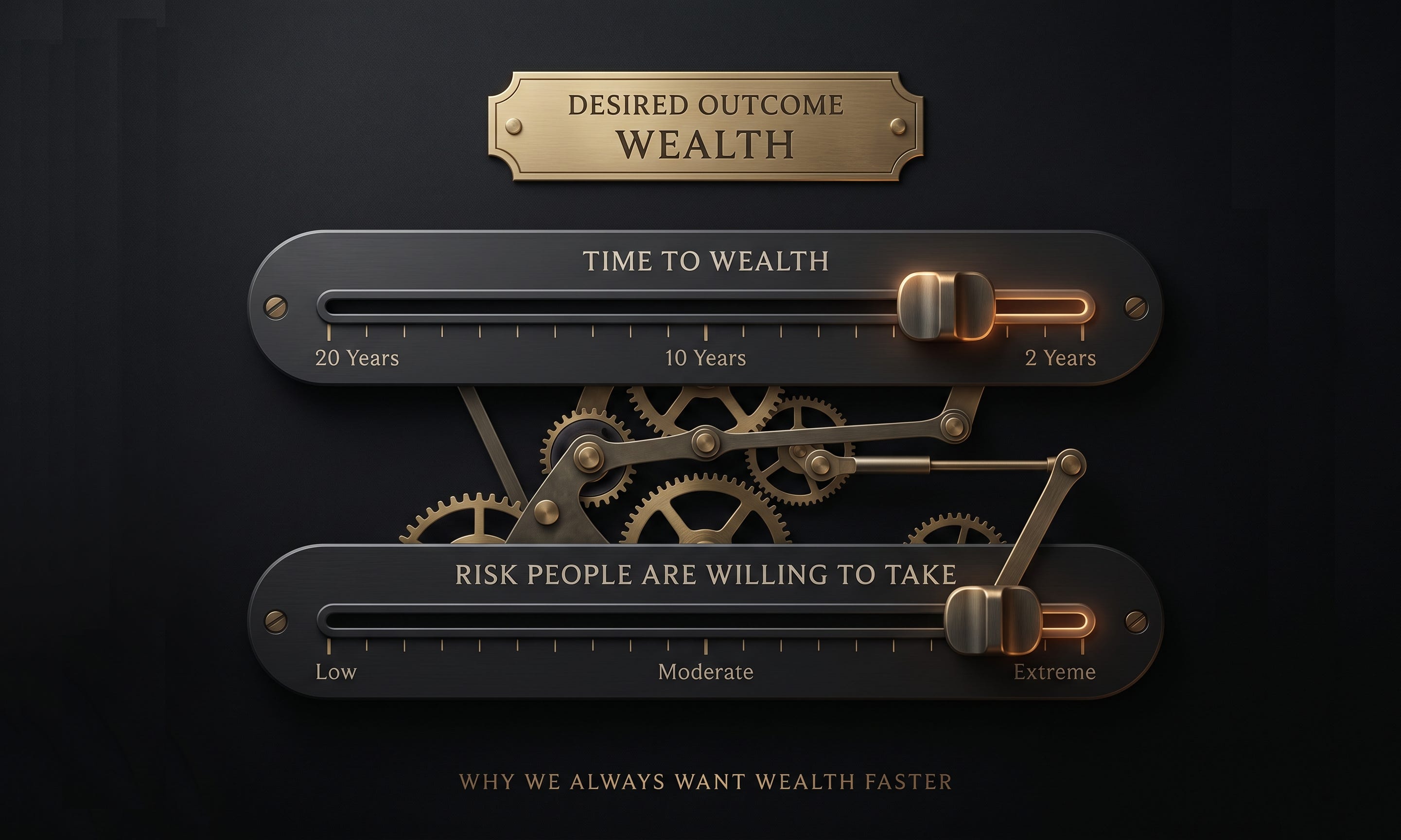
Most financial mistakes are not caused by greed. They are caused by the desire to compress time.

A Reasonable Desire Taken Too Far
Most people don’t wake up one morning and decide to do something reckless with their money.
The process is usually much more gradual than that.
It starts with something completely reasonable.
They want a better life.
They want financial security.
They want freedom.
They want options.
They want to stop worrying about money.
And they want it sooner rather than later.
There’s nothing wrong with any of that.
The problem begins when the desire for a better outcome becomes a desire for a faster outcome.
The Desire to Compress Time
People often think financial mistakes are caused by greed.
I think they’re more often caused by impatience.
Most people aren’t trying to become billionaires.
They’re trying to compress time.
Two Paths
Imagine two paths.
In the first path, you invest consistently for twenty years and gradually build wealth.
In the second path, you double your money this month.
Most people understand that the first path is more realistic.
Many still find themselves emotionally drawn to the second.
Not because they don’t understand the math.
Because they want the outcome sooner.
This Is Not Just About Investing
This isn’t unique to investing.
We see it everywhere.
People want:
rapid weight loss instead of sustainable fitness
overnight success instead of years of effort
shortcuts instead of systems
immediate gratification instead of delayed rewards
Money is no different.
Humans are wired to value today more than tomorrow.
The future always feels far away.
The rewards available right now feel real.
How Sensible Journeys Change
The interesting thing is that very few people start their financial journey looking for leverage, options, speculative trades, or risky bets.
Most start sensibly.
They save.
Then they invest.
Then they learn.
Then they see someone else making money faster.
And that’s where the journey often changes.
The Progression Toward Speculation
The progression is surprisingly predictable.
Savings.
Investments.
Stocks.
Trading.
Leverage.
Options.
Speculation.
Not because each step is inherently bad.
But because each step offers the possibility of reaching the destination sooner.
Why Shortcuts Are Attractive
The desire to get rich quickly is easy to understand.
Life is uncertain.
Bills arrive every month.
Goals feel urgent.
Retirement feels distant.
Financial freedom feels even further away.
If someone offers a way to reduce a twenty-year journey to two years, it is almost impossible not to be curious.
That’s exactly what makes shortcuts so attractive.
Why Excitement Sells
The financial industry understands this.
Patience is difficult to sell.
Excitement is not.
Nobody becomes interested in investing because they hear they might earn reasonable returns over decades.
People become interested when they hear stories of fortunes made in months.
The extraordinary always attracts more attention than the ordinary.
Even when the ordinary works far more reliably.
The Illusion of Common Success
Social media amplifies this effect.
You see the trader who turned ₹1 lakh (~$1,000) into ₹10 lakh (~$10,000).
You see the investor who bought the perfect asset at the perfect time.
You see the winner.
You rarely see the thousands of people who tried the same thing and failed.
Success is visible.
Failure is largely invisible.
This creates the illusion that extraordinary outcomes are common.
They aren’t.
They’re simply easier to notice.
The Boring Path That Works
Most wealth creation is surprisingly boring.
It involves:
Earning.
Saving.
Investing.
Waiting.
Repeating.
Year after year.
There is very little excitement in the process.
And that’s precisely why so many people abandon it.
The path works.
It just doesn’t work fast enough.
The Mistake of Increasing Risk
This is where many people make a critical mistake.
They assume that if a strategy produces wealth slowly, the solution is to increase risk.
But increasing risk doesn’t merely increase returns.
It increases the range of possible outcomes.
Some people arrive at their destination faster.
Others never arrive at all.
Time is the Mechanism
The uncomfortable reality is that time is not the enemy of wealth creation.
Time is the mechanism through which wealth creation happens.
Compounding requires time.
Businesses require time.
Careers require time.
Relationships require time.
Almost everything valuable in life requires time.
Yet people spend enormous amounts of energy trying to escape the very thing that creates the outcome they want.
The Temptation Behind Financial Mistakes
The desire to get rich faster is understandable.
It’s human.
But it is also the temptation behind many of the worst financial decisions people ever make.
Because once speed becomes the objective, almost every shortcut starts looking reasonable.
And that is usually where the trouble begins.
Making Peace With Time
The most successful investors are not always the smartest.
Often, they are simply the people who made peace with the fact that wealth takes time.
And stopped trying to outrun it.
Disclaimer
This is educational content, not financial, investment, tax, or legal advice.
Zenca shares perspectives and frameworks to help you think clearly - your decisions are your own.
Please think independently and do your own research.
I write to improve how we think about money.
If this helped you think more clearly about money, you can subscribe to Zenca to receive future essays directly.
Subscriptions are the only true ongoing signal I get that this work is valuable to others.
And if this resonated, take a few seconds to share it — it might change how someone else thinks about money too.