

Most People Don’t Have A Money Problem. They Have A System Problem.
System over impulse. Logic over emotion.

Most people think money is chaotic. Unpredictable. Emotional. Stressful.
They tell themselves stories like:
“If only I earned more, I’d be fine.”
“Once I get a raise, things will settle.”
“I’m bad with money - it just disappears.”
The truth is far simpler:
Money isn’t the problem. Lack of a system is.
Money responds to behavior.
Behavior responds to structure.
Without structure, money follows impulse.
And impulse is the enemy of financial freedom.
Money isn’t emotional. People are.
People often blame external factors for money stress - the economy, inflation, taxes, unfair companies, bad luck. But these things aren’t the real reason people stay stuck. The true reason is this:
Most people make money decisions based on impulse, not logic.
They buy when they feel desire.
They invest when they feel FOMO.
They sell when they feel fear.
They upgrade lifestyle when they feel social pressure.
Impulse is emotional. And emotional money decisions always feel reasonable in the moment - that’s why people keep repeating them.
But here’s the hard truth:
Impulse compounds into chaos.
Logic compounds into freedom.
The gap between people who stay trapped and people who build freedom is not talent or luck. It’s structure.
The illusion of progress: Why higher income doesn’t fix money problems
Everyone believes their problem is income. It isn’t.
If income solved money problems, then every high-salary professional would be financially free by 40. But that isn’t the reality. Most are one job loss away from panic. Salaries increased. Lifestyles expanded. Debt followed. Stress grew.
Income buys comfort. Systems build freedom.
A person earning ₹100,000 (~$1,000) a month with a system
can build more wealth than
someone earning ₹500,000 (~$5,000) a month without one.
That sounds uncomfortable, but it’s true - because wealth isn’t created by earning money; it’s created by keeping and compounding money.
The Cycle of Money Chaos
Most people live inside a loop they don’t even see:
Earn → Spend → Regret → Promise → Repeat
Salary comes → spending explodes → bank balance collapses
Guilt sets in → promises are made (“next month I’ll start”)
Random investments begin → no plan → no track
Something urgent happens → everything gets liquidated
Cycle restarts
This isn’t stupidity. This is structure failure. When there is no system, impulse becomes the system.
What is a Money System?
A money system is not budgeting. It isn’t motivational quotes about discipline. It isn’t “hustle harder.” It isn’t a spreadsheet fantasy.
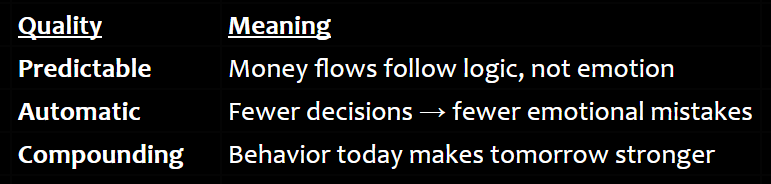
A money system is a repeatable flow that controls your money behavior automatically - even on bad days - so wealth builds regardless of mood, desire, or temptation.
If you need willpower to save and invest, you don’t have a system.
A real system has three qualities:

Money is Math + Behavior
Money is not complicated. It obeys two forces: math and behavior.

Most people obsess about the math - “Which stock? Which mutual fund? What return?”
But they ignore behavior - and behavior is 80% of money mastery.
Bad behavior destroys even great math.
Good behavior can make even average math work.
Why impulse ruins financial life
Impulse-based decisions are emotional reactions disguised as logic:
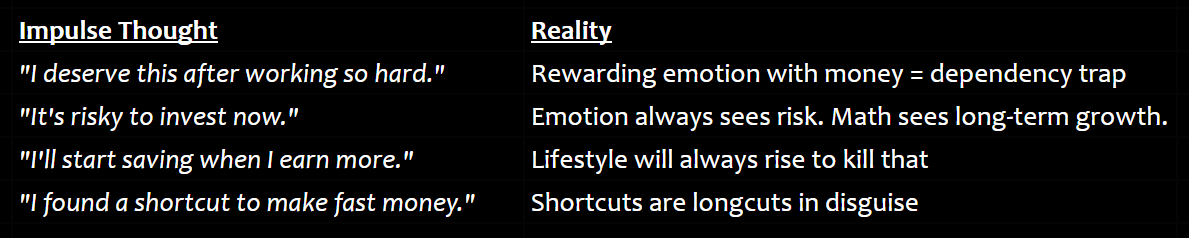
Impulse asks: “What feels good now?”
Logic asks: “What builds power later?”
The only way to beat impulse: build rules
If you don’t have rules for money, money will have rules for you.
Rules reduce decisions. Fewer decisions reduce emotion. Less emotion increases consistency. Consistency builds wealth.
Example rules for a money system:
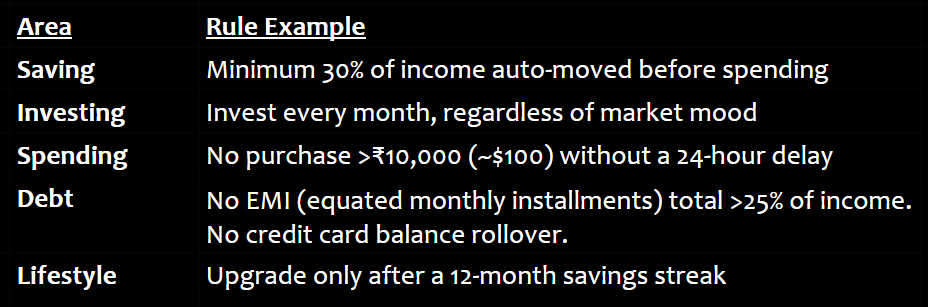
Rules don’t make life rigid. They make life free - because once the essentials are automated, your mind is released from money anxiety.
Money systems are built, not discovered
Most people think they’ll “figure out money someday.” That day never comes. Clarity doesn’t arrive. Clarity is built.
A system is built through simple, logical steps:
Phase 1: Stability
Track inflow–outflow
Automate savings
Kill high-interest debt
Build 6-month emergency reserve
Phase 2: Growth
Automate investing
Select long-term vehicles
Diversify by time horizon
Keep fees and taxes low
Phase 3: Sovereignty
Build reliable income streams
Hedge systemic risk
Reduce dependency
Design financial freedom on your own terms
Every piece of financial independence is connected to systems — not luck, not timing, not gambling, not shortcuts.
The only quest that matters
Behind every goal — better career, stronger family security, freedom to travel, time with children, opportunity to build legacy — money plays a role.
Money is not life. But money touches every part of life.
The quest to master money is not greed.
It is responsibility. It is self-respect. It is independence.
It is the difference between being controlled and being sovereign.
If you want financial freedom — truly want it — then you must win one game:
The game of system vs impulse.
Not knowledge vs ignorance.
Not rich vs poor.
Not salary vs business.
System vs impulse is the real battle.
Master this, and the rest follows.
What Zenca is about
Zenca exists for one mission: to build financial sovereignty through systems — not shortcuts. No hype. No magic formulas. No “get rich fast” scams. Just clarity, logic, math, and behavior.
Over the coming weeks, this space will break down:
✅ How to build a personal money system
✅ Logic-based decision making over emotional reactions
✅ Practical money frameworks that actually work
✅ How to protect yourself from financial traps
✅ How to build wealth without anxiety or complexity
This won’t be a one-way conversation. Use the comments. Ask questions. Challenge ideas. Let’s build this together — one layer at a time.
If this idea resonates, subscribe and stay close. Freedom begins with clarity.
Disclaimer
This is educational content, not financial, investment, tax, or legal advice.
Zenca shares perspectives and frameworks to help you think clearly - your decisions are your own.
Please think independently and do your own research.
I write to improve how we think about money.
If this helped you think more clearly about money, you can subscribe to Zenca to receive future essays directly.
Every subscription is a vote for thinking more clearly about money.
And if this resonated, take a few seconds to share it — it might change how someone else thinks about money too.