

The Cost Of Wanting Things Now (4/4) || BNPL: When Impatience Goes Instant
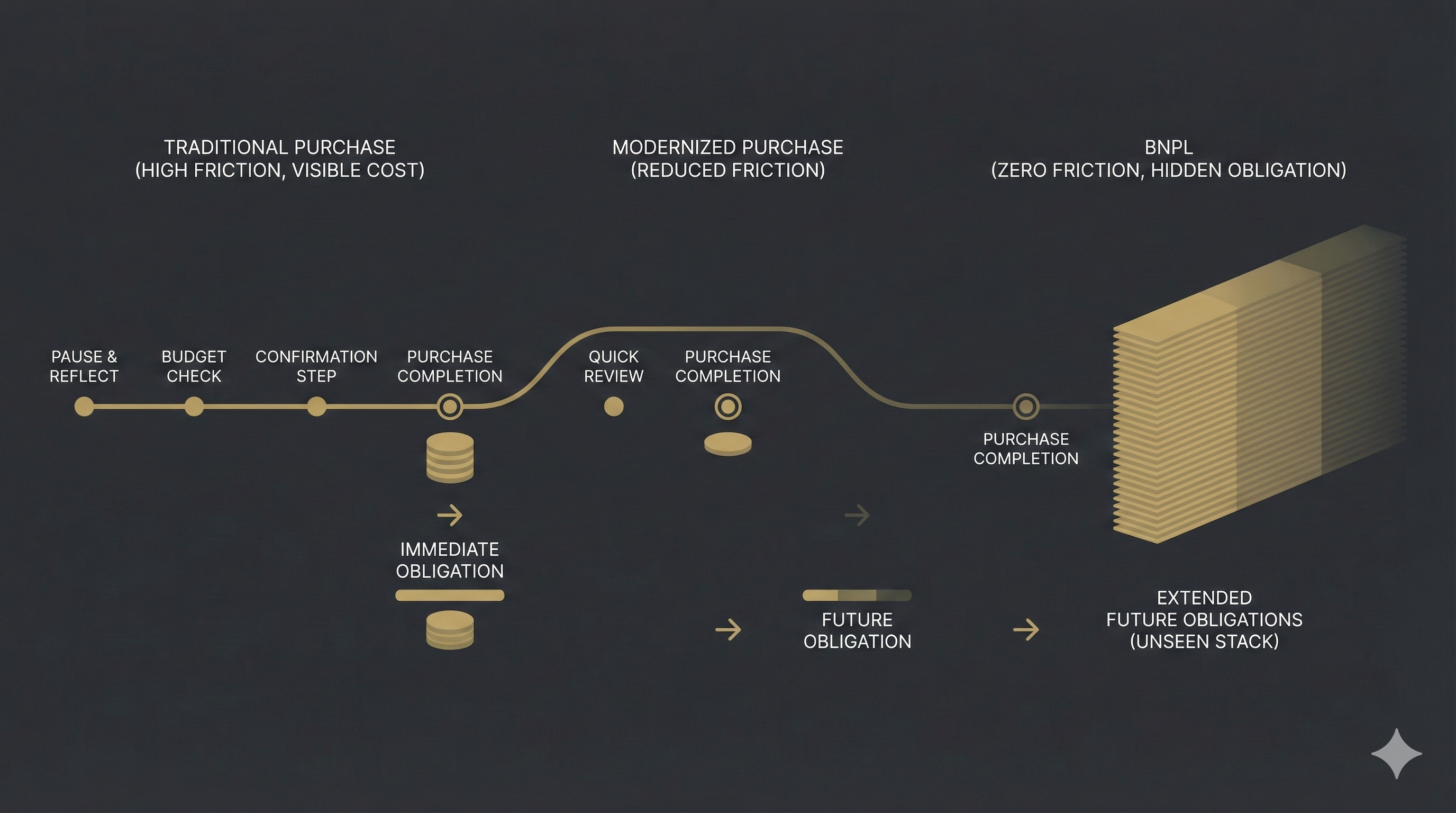
When friction disappears, reflection goes with it - but obligations don’t.

EMIs at least make you pause.
There’s paperwork.
A bank.
A tenure.
A monthly reminder that you owe money.
Buy Now, Pay Later removes all of that.
No friction.
No reflection.
No discomfort.
Just a button.
That’s not innovation.
That’s impatience, fully automated.
What BNPL really changes
BNPL doesn’t change what you buy.
It changes when you feel the cost.
Traditional payments make you feel pain before consumption.
EMIs move pain after consumption.
BNPL tries to remove pain altogether.
But pain doesn’t disappear.
It accumulates.
Why BNPL feels harmless
BNPL works because it hijacks three powerful biases:
1. The amounts are “too small to matter”
₹1,200 (~$12) here.
₹2,800 (~$28) there.
₹900 (~$9) somewhere else.
Individually insignificant.
Collectively dangerous.
2. The payment is deferred, not denied
You’re not saying no.
You’re saying:
“I’ll deal with this later.”
Later is always more accommodating than today.
3. There’s no visible debt signal
No credit card statement.
No EMI schedule.
No sense of obligation.
Just usage.
That’s the trick.
From structured debt to invisible debt
EMIs are formal.
They:
Have tenures
Force monthly discipline
Show up clearly in budgets
BNPL is informal.
It:
Spreads across apps
Avoids central visibility
Encourages stacking
You don’t feel indebted.
You just feel slightly poorer every month.
Why BNPL targets younger earners
BNPL is not designed for people with surplus.
It’s designed for people with:
Early income
Rising aspirations
Limited buffers
High social pressure
People who are still building patience as a muscle.
That’s not accidental.
It’s the business model.
The real danger isn’t default - it’s habit
Most BNPL users don’t default.
That’s not the problem.
The problem is behavioral training.
BNPL trains you to:
Prioritize desire over planning
Detach consumption from consequence
Treat future income as already spent
Once that wiring sets in, it leaks into bigger decisions:
Credit cards
Personal loans
Lifestyle inflation
Long-term financial fragility
Why BNPL never creates assets
Notice the pattern again.
BNPL is rarely used for:
Education
Skill-building
Productive tools
Long-term value creation
It’s used for:
Fashion
Gadgets
Convenience
Impulse upgrades
BNPL doesn’t finance growth.
It finances urgency.
“But I pay it off on time”
Most users say this.
And most are telling the truth.
But punctual repayment isn’t the same as financial health.
You can:
Pay everything on time
Have no overdue bills
Still quietly sabotage wealth creation
Because every BNPL payment:
Crowds out investing
Reduces slack
Steals optionality
Just without drama.
The common thread across EMIs, zero-cost EMIs, and BNPL
Different products.
Same principle.
They reduce waiting.
And waiting is not a nuisance.
Waiting is where:
Priorities clarify
Wants fade
Better decisions emerge
When waiting disappears, judgment follows.
The discipline BNPL removes
BNPL doesn’t just remove friction.
It removes self-interrogation.
That moment where you ask:
“Do I really need this?”
That moment matters more than any interest rate ever will.
The only question that matters
Before any BNPL purchase, ask:
“If I had to pay for this today, would I still buy it?”
If the answer is no, the problem isn’t the payment option.
It’s impatience wearing better UX.
Wealth is built slowly - by design
There is no shortcut around patience.
You can delay it.
You can disguise it.
You can finance around it.
But eventually, wealth only responds to one thing:
The ability to say not now - long enough.
BNPL doesn’t make things affordable.
It makes restraint optional.
And restraint is the real asset.
Closing note (series wrap)
EMIs.
Zero-cost EMIs.
BNPL.
Three products.
One trade-off.
Patience or impatience.
One compounds quietly.
The other compounds invisibly.
Choose carefully.
Disclaimer
This is educational content, not financial, investment, tax, or legal advice.
Zenca shares perspectives and frameworks to help you think clearly - your decisions are your own.
Please think independently and do your own research.
I write to improve how we think about money.
If this helped you think more clearly about money, you can subscribe to Zenca to receive future essays directly.
Every subscription is a vote for thinking more clearly about money.
And if this resonated, take a few seconds to share it — it might change how someone else thinks about money too.