

The Fear & Greed Lens: Why Sentiment Drives Markets More Than Numbers Do
When you understand sentiment, you stop reacting to the crowd - and start thinking for yourself.

Most people think markets move because of data.
But look closely and you’ll realise: markets move because people do.
Every rise and fall, every breakout and crash, every irrational stretch on both sides of a chart - it’s always psychology first, numbers second.
Across Bitcoin, U.S. equities, and Indian markets, sentiment plays a far bigger role than most investors admit. And while the tools used to measure that sentiment differ, they all point to the same idea:
Fear and greed dictate behaviour.
Behaviour dictates decisions.
Decisions dictate outcomes.
In this piece, let’s understand how different markets measure fear and greed, how reliable these measures really are, and how to use them intelligently - not reactively.
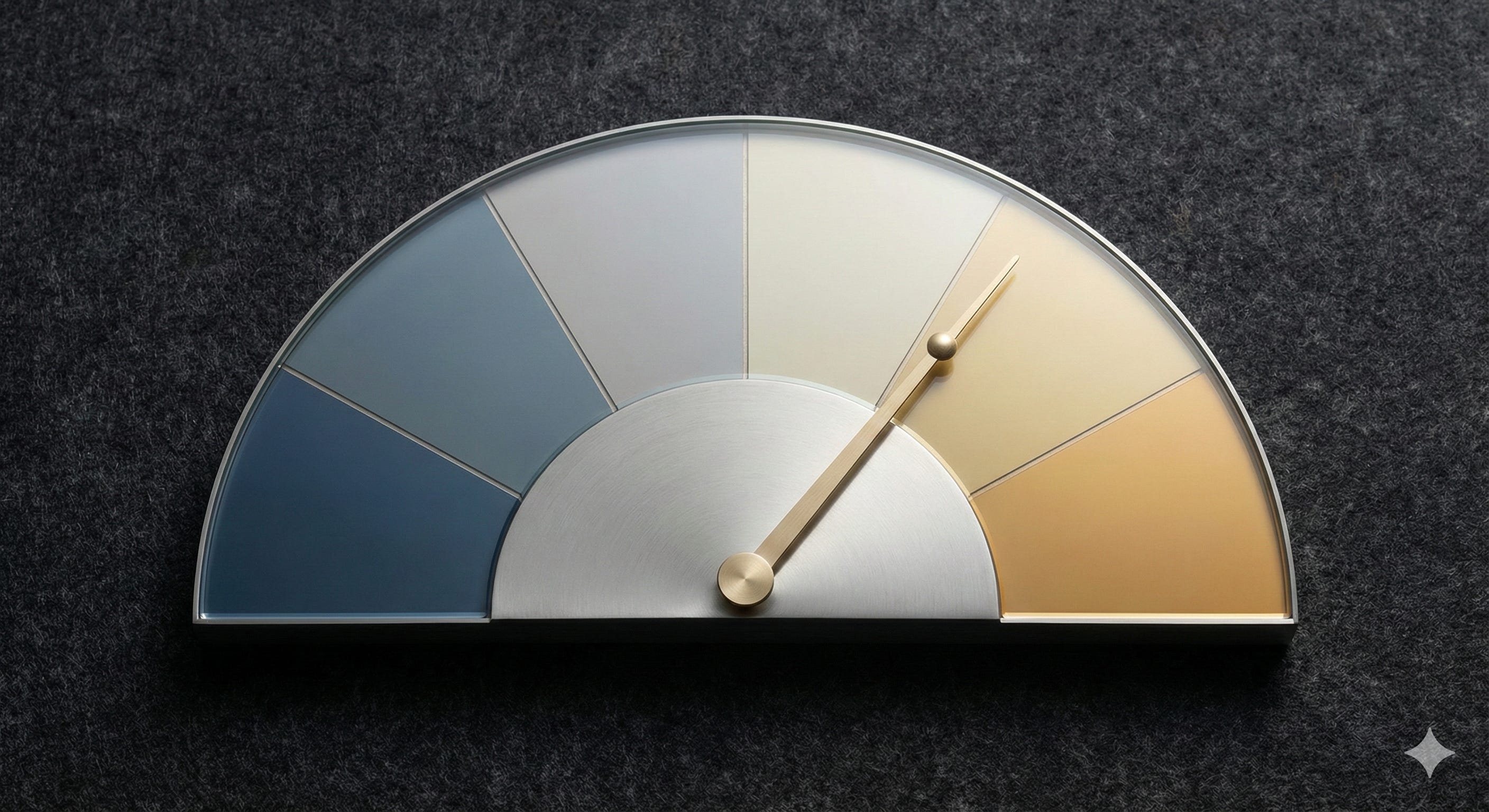
Bitcoin: The Purest Reflection of Retail Emotion
Bitcoin’s price history is basically a live behavioural experiment.
The Bitcoin Fear & Greed Index (the one you often see on alternative.me) tries to capture this sentiment using:
Volatility (25%)
Market momentum / volume (25%)
Social media (15%)
Bitcoin dominance (10%)
Search interest (Google Trends) (10%)
Surveys (15% - currently paused)
It’s imperfect, but it’s surprisingly good at one thing:
Measuring retail emotion at the extremes.
Below 25 → fear everywhere.
Above 75 → risk disappears from the conversation.
Bitcoin behaves like a mirror: it reflects your own emotional state if you stare at it too long. That’s why sentiment indicators matter - not for prediction, but for self-awareness.
U.S. Equities: Where Sentiment Meets Structure
CNN’s U.S. Fear & Greed Index relies on market-driven signals, not mood-driven ones:
S&P 500 momentum
Stock price strength & breadth
Put/Call options ratio
Market volatility (VIX)
Safe-haven flows
Junk bond demand
This works because U.S. markets are institutional.
When sentiment shifts, it shows up in hedging, liquidity, bond spreads, and portfolio rotation - not in tweets or search spikes.
These aren’t opinions.
These are capital decisions.
Together with Bitcoin’s raw emotion, you get the full spectrum:
From retail impulses to institutional risk management.
India: Sentiment Without a Single Index
India doesn’t have a single unified fear-greed index.
But sentiment reveals itself through:
India Volatile Index (VIX)
High = fear. Low = complacency.
Put/Call Ratio
Extreme values signal short-term emotional swings.
Market Breadth
Narrow rallies are almost always greed-driven tops.
Foreign vs Domestic Institutional Investors Flows (FII vs DII)
FII exits often trigger fear.
DII buying on dips often signals steady conviction.
Smallcap/Midcap Premium
India’s most reliable sentiment tell.
A frenzy in smallcaps = greed.
A collapse = fear.
Put these together, and you get an accurate behavioural read even without a formal index.
Understanding Sentiment Through a Simple Truth
There’s an old line often attributed to Baron Rothschild:
“Buy when there is blood on the streets, even if the blood is your own.”
This isn’t about courage.
It’s about recognising what extreme fear actually means.
When sentiment collapses, people don’t sell because assets are worthless.
They sell because they’re terrified.
They sell without thinking.
They sell because others are selling.
They sell because they want the pain to stop.
And when enough people do this at once, prices detach from fundamentals and reflect pure fear.
That’s why fear matters.
It pushes prices to places logic never would.
Similarly, when greed takes over, something else happens:
People stop asking “Is this expensive?”
They start asking “What if it goes even higher?”
Risk becomes invisible.
Discipline disappears.
Prices stretch far beyond what is reasonable.
Extreme greed doesn’t mean the market is strong.
It means the market is overextended.
That’s why sentiment extremes are so important:
When everyone is fearful, prices tend to be the lowest.
When everyone is greedy, prices tend to be the highest.
Not because the market is predictable — but because human behaviour is.
The Only Thing That Matters: Extremes
You can ignore sentiment most of the time.
But not when it hits the boundaries.
Extreme Fear → capitulation, panic-selling, distressed prices
Extreme Greed → euphoria, overvaluation, exhaustion tops
Sentiment doesn’t tell you what to do.
It tells you the environment your decisions are being made in.
And that awareness itself changes the quality of your decisions.
How You Should Actually Use Fear & Greed Indices
Here’s the simplest way to approach it:
Use sentiment to understand behaviour - not to predict prices.
Fear & Greed indices won’t tell you whether tomorrow is green or red.
But they will tell you how emotional the market is today.
And the more emotional the crowd, the more intentional you need to be.
Because markets don’t move because they’re rational.
Markets move because people aren’t.
Fear and greed don’t shape markets on their own.
People do.
And understanding people - especially yourself - is the real edge.
Disclaimer
This is educational content, not financial, investment, tax, or legal advice.
Zenca shares perspectives and frameworks to help you think clearly - your decisions are your own.
Please think independently and do your own research.
I write to improve how we think about money.
If this helped you think more clearly about money, you can subscribe to Zenca to receive future essays directly.
Every subscription is a vote for thinking more clearly about money.
And if this resonated, take a few seconds to share it — it might change how someone else thinks about money too.