

Understanding Markets: Price, Value & Human Behaviour
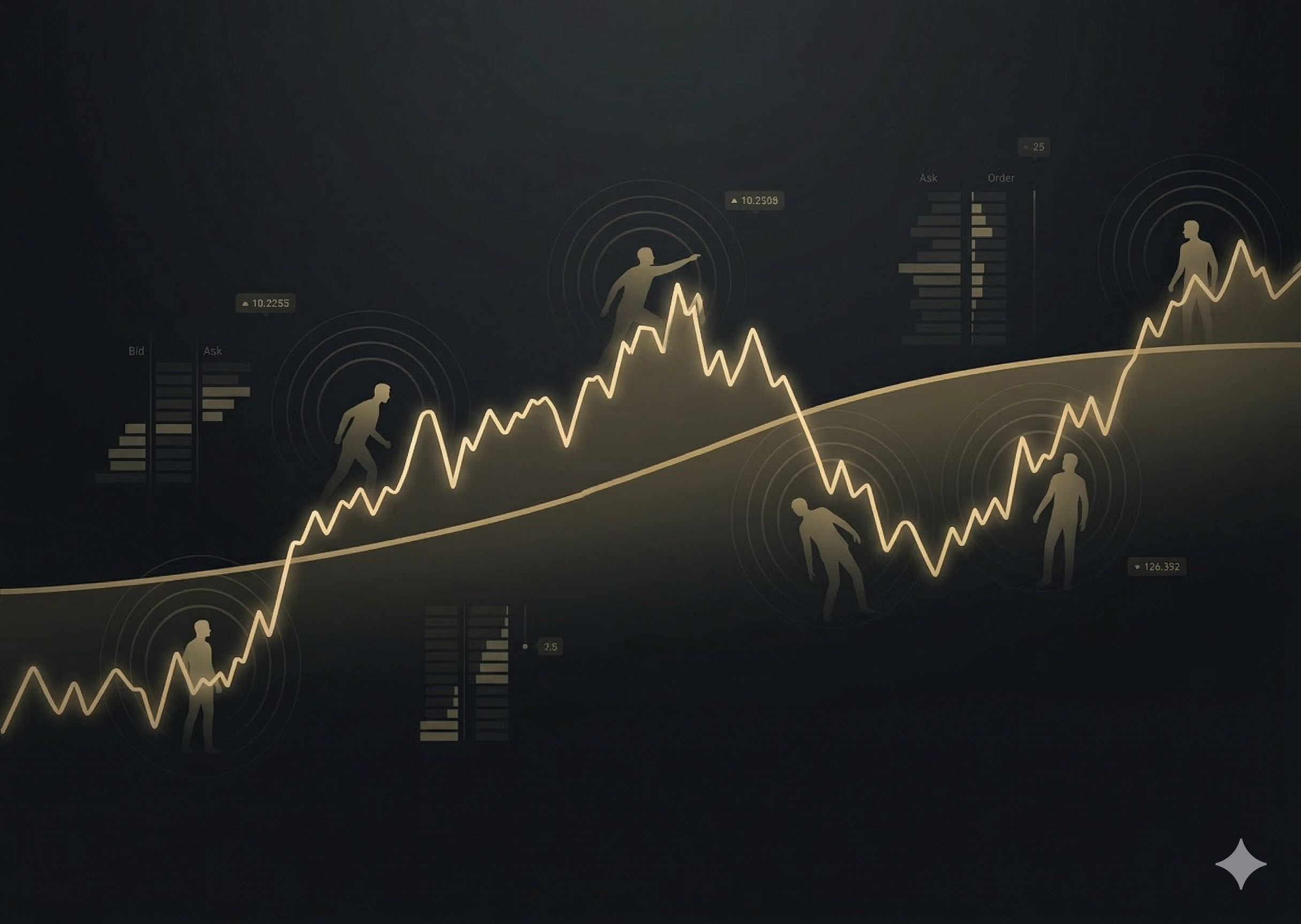
Markets don’t move on value. They move on behaviour - and price is simply the latest agreement.

“Price is what you pay. Value is what you get.”
— Warren Buffett
Preface - Why We Study Price and Value
Every day, millions of people buy and sell something - stocks, real estate, bitcoin, art, even time.
Each transaction produces a single number: price.
We spend our lives reacting to that number - celebrating when it rises, worrying when it falls - but rarely stop to ask what it truly means.
Understanding price is not just about finance; it’s about human nature.
It teaches us how we perceive worth, handle emotion, and make decisions in the presence of uncertainty.
This essay unpacks that world - layer by layer - so you can see what actually moves prices, what doesn’t, and why true wealth is built not on prediction, but on perspective.
What Is a Price?
A price is not a prediction, an opinion, or a statement of worth.
It’s simply the last number at which two minds agreed.
One said, “I’m willing to pay that much.”
The other said, “I’m willing to let it go for that.”
The trade happened, and that number became the price - until the next handshake.
That’s all a market ever shows you: the record of the most recent agreement.
It tells you where optimism and pessimism briefly met.
Prices change every second because human conviction changes every second.
Information spreads, emotions shift, and the willingness to act moves with them.
Price isn’t the truth of value - it’s the timestamp of the last compromise.
A price on its own tells us where a trade happened - but not how.
To see what makes that number move, we need to look under the surface - at the structure where every buy and sell order quietly waits to be matched.
That structure is the order book, and it’s where the real story of price begins.
The Order Book and Price Movement
Behind that single printed price lives an entire ecosystem - the order book.
On one side stand the buyers, each posting a bid:
“I’ll buy one at ₹99 (~$0.99).”
“I’ll buy two at ₹98 (~$0.98).”
On the other side wait the sellers, each with an ask:
“I’ll sell one at ₹101 (~$1.01).”
“I’ll sell three at ₹102 (~$1.02).”
At any moment the highest bid and the lowest ask form a narrow gap.
When a buyer grows impatient and says, “Fine, I’ll pay ₹101 (~$1.01),” the trade clears, and the price moves up.
When a seller blinks first and accepts ₹99 (~$0.99), the price ticks down.
This constant crossing of bids and asks is the heartbeat of every market - nothing mystical, just human impatience meeting human hesitation, over and over again.
The market doesn’t move because time passes - it moves because someone decides not to wait.
But even the most elegant mechanics can’t explain the chaos of markets on their own.
Behind every bid and ask are people - impatient, emotional, and often irrational.
To understand why prices sometimes move far beyond reason, we have to study the psychology that drives those trades.
The Psychology Behind Price Changes
Every market chart is a portrait of collective emotion.
Fear, greed, hope, and impatience all leave fingerprints in every rise and fall.
When optimism takes hold, buyers start chasing higher and higher prices.
The more the price rises, the more new buyers appear - each convinced it will keep rising.
Their very act of buying drives prices up further, confirming the belief that drew them in.
The loop feeds itself: rising prices attract buyers, and those buyers make prices rise.
The same reflex works in reverse.
When prices start to fall, fear spreads.
Sellers rush to exit, pushing the price down faster.
Each new drop validates the panic of those still holding, and soon everyone’s selling simply because everyone else is.
Falling prices attract sellers, and those sellers make prices fall.
Economists call this reflexivity - a feedback loop where perception and reality chase each other in circles.
It’s not manipulation; it’s human nature amplified through markets.
Markets don’t just mirror emotion - they magnify it.
Knowing when you’re inside the loop is half the skill of staying out of it.
But not every move deserves equal attention.
Some surges are real shifts in belief, backed by thousands of trades; others are just the noise of a few impatient hands.
To tell which is which, we must look deeper - at volume and liquidity, the two forces that reveal whether a price move carries conviction or is merely an emotional ripple.
Volume, Liquidity and Meaning
Not every price change carries the same weight.
Sometimes a tiny trade moves the price a lot; other times, millions change hands and the price barely twitches.
The difference lies in volume and liquidity - the two silent forces that decide how meaningful a price move really is.
Volume is the total quantity traded.
When prices move on high volume, it means many participants agree with the new level - it carries conviction.
When prices move on low volume, it means only a few impatient traders caused it - it’s more likely noise than signal.
Liquidity is about depth: how many buy and sell orders sit across different price levels.
In a liquid market, there are enough buyers and sellers at every step, so even large trades barely move the price.
In an illiquid market, just one big order can cause sharp swings because there aren’t enough counterparties to absorb it.
A price tells you where a trade happened; volume and liquidity tell you how real that move was.
Once we can tell the difference between noise and conviction, we can finally ask the bigger question:
Does this movement reflect a change in actual worth?
Because while prices flicker constantly, value moves at a much slower, steadier pace.
Price vs Value - The Core Difference
The market price may change every second; value usually doesn’t.
Price captures emotion, liquidity, and urgency.
Value reflects something steadier - the real utility, earning power, scarcity, or trust embedded in the thing being bought or sold.
Think of a company: its price can swing 5% in a day because of headlines, but its value - the quality of its products, leadership, and cash-flow potential - barely shifts overnight.
Real estate works the same way.
Bitcoin too: the market re-prices it minute by minute, but its core properties - finite supply, open network, censorship resistance - don’t fluctuate at all.
Traders interpret emotion; investors interpret essence.
Price tells you what the crowd feels now; value tells you what reality will prove later.
Knowing that price and value often drift apart raises a practical challenge: what do we do when they diverge?
That’s where the craft of investing begins - in learning how to use the gap between perception and reality to your advantage.
How Investors Use the Gap
The real edge in investing comes from spotting the gap between price and value - and having the conviction to act before everyone else sees it.
When fear dominates, prices fall below what things are truly worth.
When greed takes over, prices climb above it.
Both are temporary distortions in perception.
Value investors make their living by buying when pessimism creates bargains, and selling when optimism turns assets expensive.
It’s not prediction - it’s discipline.
The crowd reacts; investors anticipate.
Profit lies not in predicting the future, but in recognizing when the present is wrong.
But even with perfect logic and strategy, one ingredient determines who succeeds: time.
Markets don’t reward speed; they reward endurance.
To understand why, we must step back and see how time reshapes both prices and beliefs.
The Time Dimension
Time is the great equalizer in markets.
It filters out emotion, exposes illusion, and reveals what truly endures.
In the short term, the market behaves like a voting machine - counting opinions, hype, and panic.
In the long term, it transforms into a weighing machine - measuring substance, results, and truth.
Every asset moves through these cycles of noise and normalization.
The challenge isn’t predicting when they end - it’s surviving them without losing conviction.
Time doesn’t change value; it reveals it.
The market eventually weighs everything - patience included.
Over long horizons, time filters emotion and reveals truth - yet modern assets seem to defy this patience.
In a world where everything trades every second, what does “long term” even mean?
The answer becomes clear when we look at the ultimate test case for modern value discovery: Bitcoin.
Applying It to Bitcoin and Modern Assets
Every asset lives through the same tension between price and value, but nowhere is it more visible than in Bitcoin.
Bitcoin is perhaps the world’s first truly global, continuously traded, highly liquid asset - making it one of the purest real-time expressions of price, value, and human behaviour.
Its price moves by the second, reflecting emotion, liquidity, and headlines: ETFs, regulations, tweets, wars, elections.
Its value, however, is built from slower, deeper foundations - mathematical scarcity, global accessibility, network security, and the collective trust of millions verifying every transaction.
Each cycle of hype and despair simply brings more people to understand what it actually is.
This is true for modern assets more broadly - tech stocks, real estate, commodities, even art.
They all oscillate between sentiment-driven pricing and slow-moving value.
Prices shout; value whispers.
In Bitcoin, as in life, the reward belongs to those who can hear the whisper through the storm.
Closing Reflection - What This Teaches Us About Financial Independence
Learning how prices form - and how they differ from value - changes how you see everything.
You stop fearing volatility. You stop reacting to headlines.
You start thinking in longer arcs.
Money, markets, and meaning are not about constant movement; they’re about understanding cycles - of emotion, of belief, of time.
Once you learn to see clearly through those cycles, you realize that financial independence isn’t about having more - it’s about needing less noise to feel secure in your own conviction.
Every price tells a story about human behaviour.
Every investor tells a story about their own.
The goal is to make sure your story outlasts the market’s mood.
Disclaimer
This is educational content, not financial, investment, tax, or legal advice.
Zenca shares perspectives and frameworks to help you think clearly - your decisions are your own.
Please think independently and do your own research.
I write to improve how we think about money.
If this helped you think more clearly about money, you can subscribe to Zenca to receive future essays directly.
Subscriptions are the only true ongoing signal I get that this work is valuable to others.
And if this resonated, take a few seconds to share it — it might change how someone else thinks about money too.