

When Exchanges Feed FOMO - And What They Could Do Instead
How exchanges shape your behaviour long before you decide to buy.

Most new investors genuinely believe they’re making independent decisions.
But the truth is: in modern markets, your behaviour is heavily shaped by the platform you use.
Even exchanges have to take some blame for the way they attract investors.
The moment prices rise, notifications start flashing on your phone:
“Bitcoin hits a new all-time high!”
“ETH surges 12% - don’t miss out!”
It feels exciting.
But this isn’t education.
It’s emotional engineering.
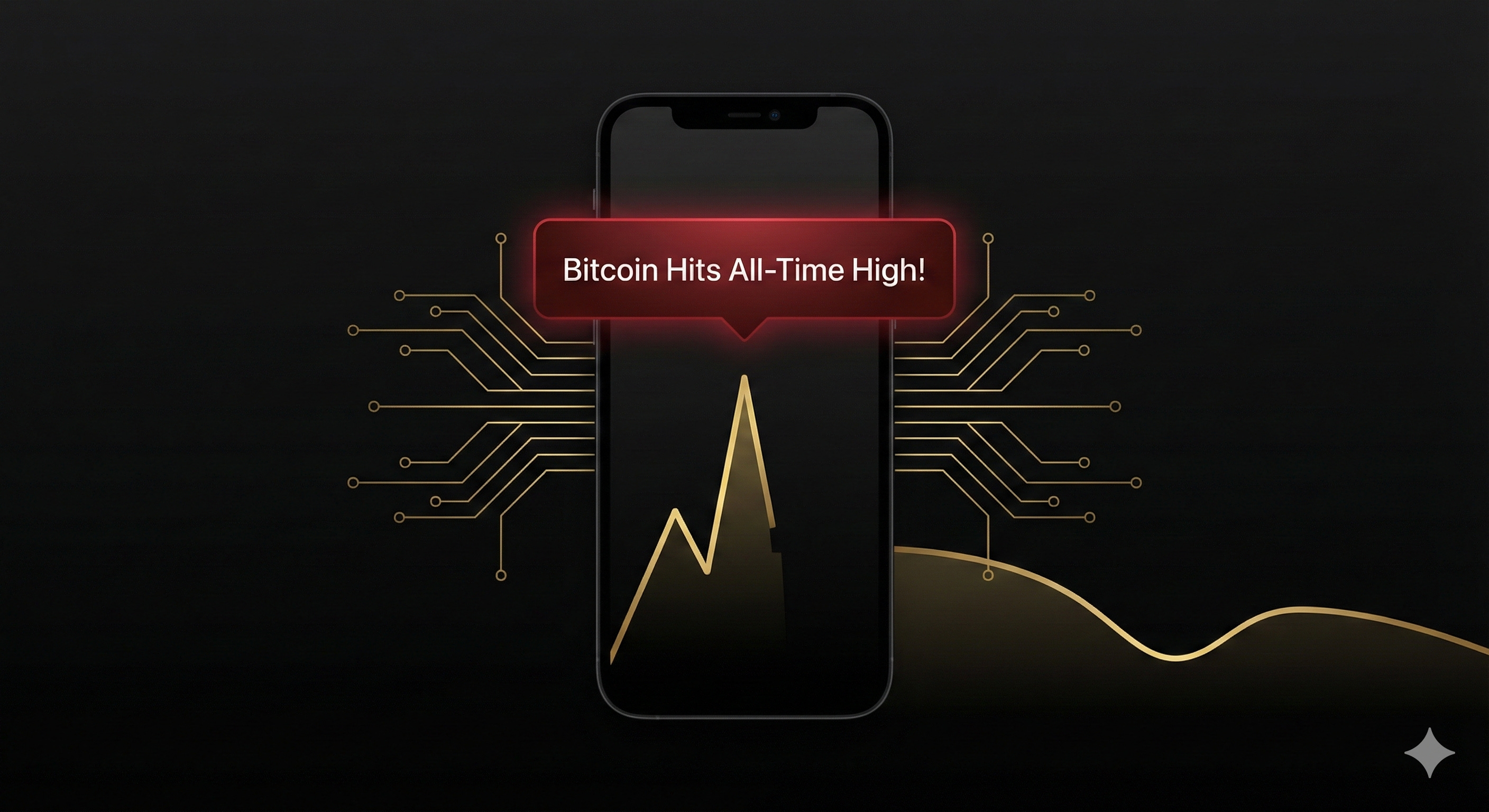
Exchanges know exactly what those alerts do to the human brain. They know that when people see prices exploding, they act out of FOMO, not rational planning. And in a human-driven, volatile market, nothing is more dangerous than a decision made under emotional pressure.
Their incentives don’t help either.
Exchanges earn from trading volume - not from whether you make or lose money. Their revenue increases when you click, trade, FOMO, panic, repeat. So the system quietly rewards impulsiveness while pretending to promote “awareness.”
The result is predictable:
People buy high, sell low, and repeat the cycle for years.
The Missed Opportunity: What Exchanges Could Do
There’s one powerful shift in behaviour that exchanges could enable - but choose not to.
Instead of celebrating every new ATH with fireworks and dopamine, they could highlight dips as potential opportunities:
“Bitcoin is down 15% - revisit your long-term plan.”
“Corrections are normal; review your strategy before reacting.”
“If you have conviction, falling prices may be where generational entries happen.”
Not as advice.
Not as certainty.
Just as context.
After all, the most successful long-term investors don’t buy the top.
They buy the right asset when it falls the most - assuming they’ve done the work to understand it, believe in it, and hold through volatility.
But dip-buying requires:
judgment
patience
conviction
and a long-term lens
These qualities generate less trading revenue than FOMO-driven buying at the top.
And that’s why exchanges rarely nudge users in this direction.
Why Buying the Top Feels Safe - and Why It’s Not
Most people buy at all-time highs because it feels validating:
“The price is rising, so it must be good.”
“Everyone seems to be getting in - I shouldn’t be left out.”
“This must be the right moment.”
But buying near ATHs is almost never smart.
It’s where risk is highest, not lowest.
In contrast, corrections - the same corrections people fear - are often where the best long-term asymmetric entries exist. But fear clouds judgment more than logic can correct it.
This is where exchanges have a huge opportunity to reshape behaviour.
Imagine if the nudges we received reinforced discipline rather than excitement.
Imagine if platforms reminded you to follow your strategy, not your emotions.
Imagine if education replaced adrenaline as the default user experience.
The entire market would look different.
A Healthier Way Forward
Exchanges won’t change voluntarily - their business models are built around engagement, not outcomes.
But users can change how they respond.
If your investment moves are driven by push notifications, you’re not investing - you’re being moved by design.
You’re reacting to a game instead of playing one.
The real skill is learning to:
ignore the noise
lean on your conviction
buy when things feel uncomfortable
build positions slowly
and stay detached from the herd cycle
Retail doesn’t need more price alerts.
Retail needs better mental models.
Because the investor who learns to filter out excitement and lean into logic is the investor who stops being exit liquidity - and starts building long-term wealth.
The Zenca View
The goal isn’t to blame exchanges.
It’s to understand that their incentives are not your incentives.
And that unless you build internal discipline, the market will always overpower your emotions.
All-time highs are not buying signals.
Dips are not danger signals.
And platforms should do more to highlight this - even if it means lower short-term revenue.
If exchanges truly cared about healthy investor behaviour, they would design systems that amplify education, not emotion.
Until then, the responsibility falls on each investor to see the game for what it is - and learn how to play it with clarity rather than fear.
Disclaimer
This is educational content, not financial, investment, tax, or legal advice.
Zenca shares perspectives and frameworks to help you think clearly - your decisions are your own.
Please think independently and do your own research.
I write to improve how we think about money.
If this helped you think more clearly about money, you can subscribe to Zenca to receive future essays directly.
Every subscription is a vote for thinking more clearly about money.
And if this resonated, take a few seconds to share it — it might change how someone else thinks about money too.