

Why Falling Prices Feel Like Danger - Even When They’re Opportunity
The psychological inversion that causes investors to sell when markets become cheaper.

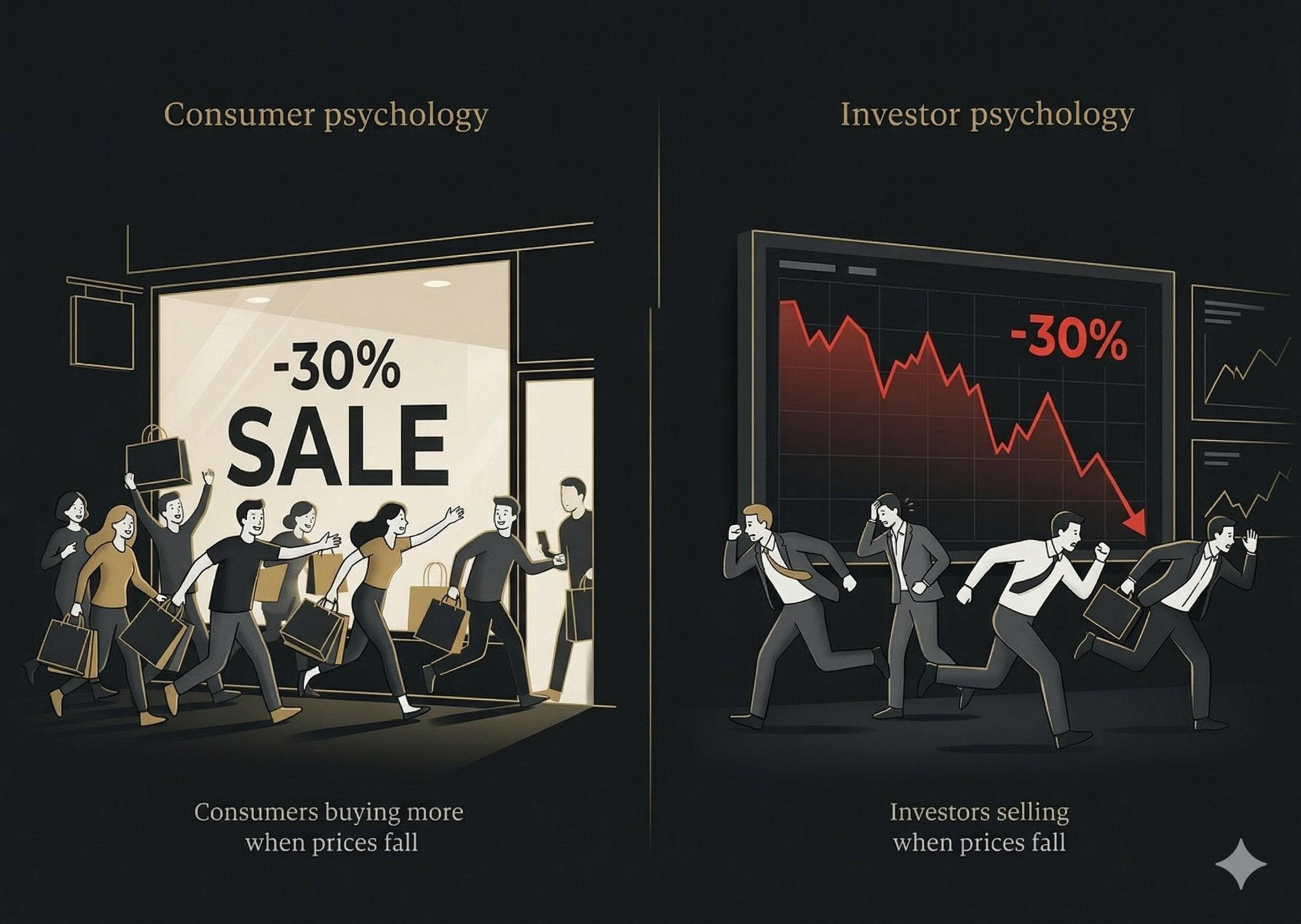
Imagine two scenarios.
A store announces a 30% discount sale.
People rush in.
Now imagine the stock market falls 30%.
People rush out.
Same price movement.
Completely opposite reactions.
In everyday life, falling prices feel like opportunity.
In markets, they feel like danger.
And that simple psychological inversion explains why many investors end up doing the exact opposite of what long-term investing requires.
The Hidden Mental Model Most Investors Carry
Most people assume that when the price of something falls, something must be wrong.
This assumption works perfectly well in everyday life.
If a restaurant is suddenly empty, you assume the food might be bad.
If a product goes on a massive discount, you suspect there’s a catch.
In most situations, falling prices signal declining value.
But markets are one of the rare systems where this intuition often fails.
And that’s why so many investors end up selling at exactly the wrong time.
Where This Mental Model Comes From
Many first-time investors enter markets with a mental model shaped by products like:
Fixed-return instruments (like fixed deposits (FDs) in India)
Recurring deposits
Insurance savings plans
Government savings schemes
These instruments have a defining feature:
Their value never goes down.
Returns may be modest, but they are predictable and always positive.
So when people begin investing in market-linked assets, they subconsciously carry the same expectation:
Investments should grow steadily over time.
When prices move like this, everything feels normal:
Month 1: ₹100 (~$1)
Month 2: ₹103 (~$1.03)
Month 3: ₹105 (~$1.05)
But markets rarely behave like that.
Instead, they look more like this:
Month 1: ₹100 (~$1)
Month 2: ₹104 (~$1.04)
Month 3: ₹97 (~$0.97)
Month 4: ₹102 (~$1.02)
The moment the price dips, something feels wrong.
Even when nothing actually is.
When Prices Fall, Fear Fills the Information Gap
Another instinct kicks in when markets drop.
People assume that someone else knows something they don’t.
Markets aggregate millions of participants.
So a falling price feels like hidden information is being revealed.
Even if an investor cannot identify the reason, the thought creeps in:
“If the price is falling, maybe others know something bad is coming.”
This creates a powerful combination:
uncertainty
lack of information
fear of further losses
And the instinctive reaction becomes simple:
Sell before things get worse.
The Psychology Behind Panic Selling
Three behavioral biases amplify this reaction.
Loss Aversion
Humans feel losses far more intensely than gains.
A 10% fall hurts much more than a 10% rise feels good.
So the emotional pressure to stop the loss becomes overwhelming.
Recency Bias
The human brain tends to project recent events into the future.
If prices fall for a few days, it feels like they will keep falling.
But markets move in cycles - often reversing long before the average investor expects.
Lack of a Mental Model
Most investors are told that markets “go up in the long run.”
But few are taught why prices fluctuate along the way.
Without that understanding, volatility feels random.
And randomness feels dangerous.
Instinct vs Understanding
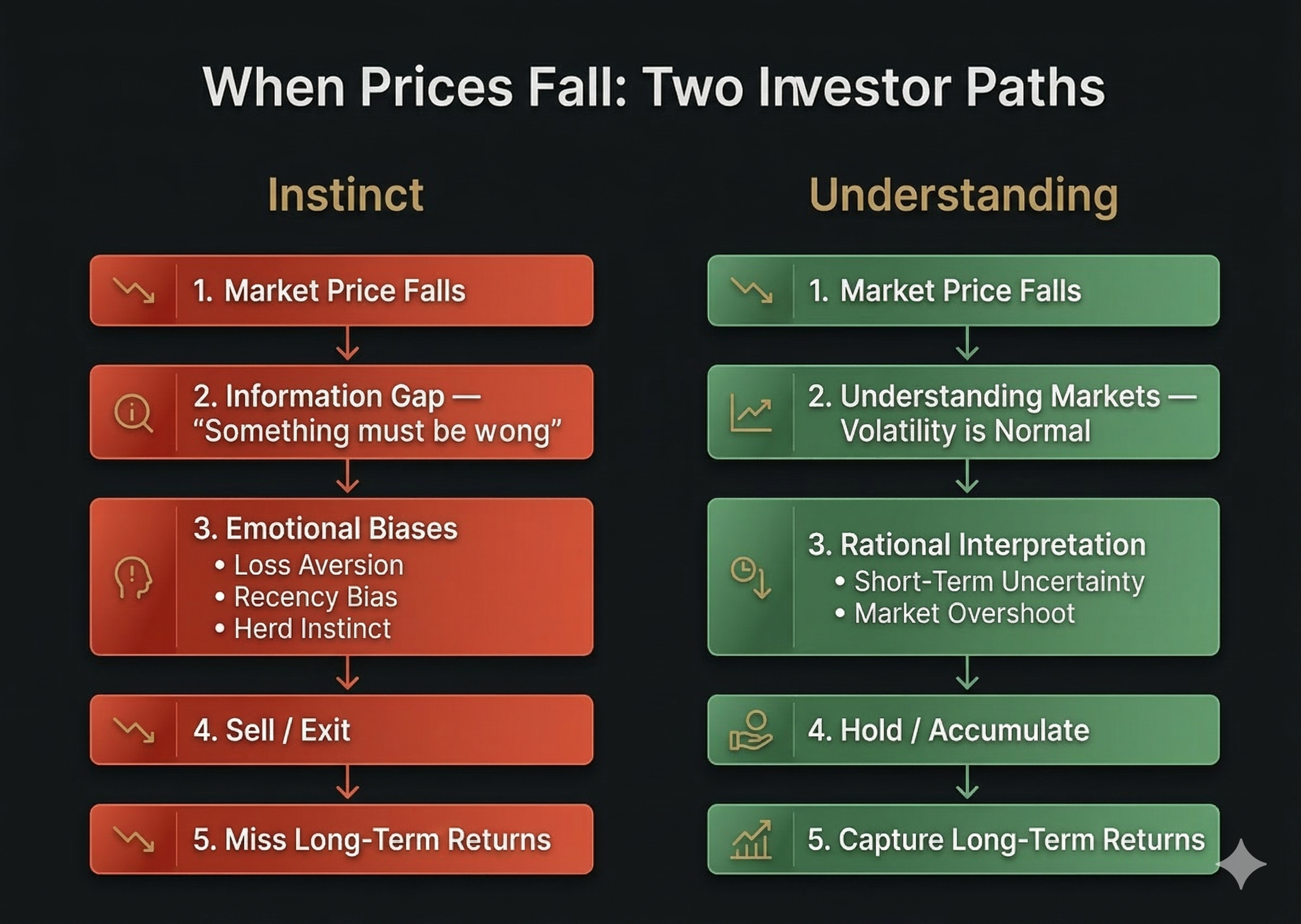
When prices fall, investors tend to split into two psychological paths.
Instinct
Price falls.
An information gap appears.
Something must be wrong.
Fear fills the uncertainty.
Emotional biases activate:
loss aversion
recency bias
herd instinct
The natural reaction becomes:
Sell. Exit. Protect what remains.
Understanding
Price falls.
But instead of panic, the investor interprets the situation differently.
Markets fluctuate.
Volatility is normal.
Short-term uncertainty does not necessarily mean long-term deterioration.
So instead of exiting, the investor holds - or even accumulates.
Over time, this behavior captures the long-term returns markets generate.
The Real Difference
The difference between these two paths is not intelligence.
It is mental framing.
Consumers are trained to interpret falling prices as opportunity.
Investors are conditioned to interpret falling prices as danger.
The same price movement creates opposite behavior because the psychological frame changes.
What Falling Prices Actually Mean
In most cases, falling prices reflect one of two things.
Temporary Uncertainty
Markets constantly respond to new information.
Interest rates change.
Earnings fluctuate.
Economic conditions evolve.
Prices adjust quickly - often faster than the underlying reality.
Overshooting
Markets rarely move in perfect proportion to reality.
They tend to overshoot in both directions.
Prices often become too optimistic during booms
and too pessimistic during downturns.
That imbalance is part of how markets discover fair value.
Why Doing Nothing Is Often the Right Move
If you are invested in a diversified asset class, a fall in price does not necessarily mean permanent loss.
It may simply reflect temporary sentiment.
The businesses, technologies, and economic activity underlying those assets continue to exist.
Which means that in many situations, the most rational action is surprisingly simple:
Do nothing.
And if the long-term outlook remains intact, lower prices can even improve future returns.
Because the same asset is now available at a cheaper price.
The Crucial Distinction: Stocks vs Asset Classes
This is where nuance becomes important.
Individual Stocks
A single company can fail permanently.
History is full of examples:
Nokia
Enron
Kingfisher Airlines (India)
Reliance Capital (India)
In such cases, falling prices may reflect genuine structural damage.
Selling may be rational.
Asset-Class Instruments
An index fund representing an entire market behaves very differently.
Consider broad indices such as:
Nifty 50 (India’s benchmark index)
S&P 500
Global equity indices
When companies decline, they are gradually replaced by stronger ones.
The index evolves alongside the economy itself.
Over long periods, its direction tends to follow:
economic growth
productivity improvements
inflation
Which historically trends upward.
The Market Paradox
The same volatility that scares investors is also what makes long-term returns possible.
If markets moved in a perfectly smooth line like this:
₹100 (~$1)
₹101 (~$1.01)
₹102 (~$1.02)
₹103 (~$1.03)
₹104 (~$1.04)
there would be almost no risk.
And without risk, there would be no meaningful reward.
Volatility is not a flaw in markets.
It is the price investors pay for long-term growth.
Reframing Market Declines
Instead of seeing falling prices as danger, it can be useful to think of them as temporary markdowns on productive assets.
In everyday life, people love discounts.
But in markets, people often react the opposite way:
rising prices attract buyers
falling prices trigger panic
Learning to reverse that instinct is one of the most important skills an investor can develop.

(Conceptual visual showing how the same shock produces different long-term outcomes.)
A Simple Question to Ask
Whenever markets fall, it helps to ask one question:
Has the asset fundamentally broken?
Or
Has the price simply moved?
If the underlying system remains intact, falling prices are often not a signal to run away.
They are simply a reminder of how markets actually work.
Disclaimer
This is educational content, not financial, investment, tax, or legal advice.
Zenca shares perspectives and frameworks to help you think clearly - your decisions are your own.
Please think independently and do your own research.
I write to improve how we think about money.
If this helped you think more clearly about money, you can subscribe to Zenca to receive future essays directly.
Every subscription is a vote for thinking more clearly about money.
And if this resonated, take a few seconds to share it — it might change how someone else thinks about money too.