

Why The Dollar Moves: A Simple Mental Model That Explains Everything
The ₹/$ rate isn’t a mystery. It’s a live balance of pressure - between people who need dollars and those willing to give them up.


It’s just a price
Most people think the dollar–rupee rate is some abstract number.
It isn’t.
It’s just a price.
What does “rupee strengthening” or “weakening” actually mean?
The exchange rate is just a measure of:
How many rupees it takes to buy 1 dollar
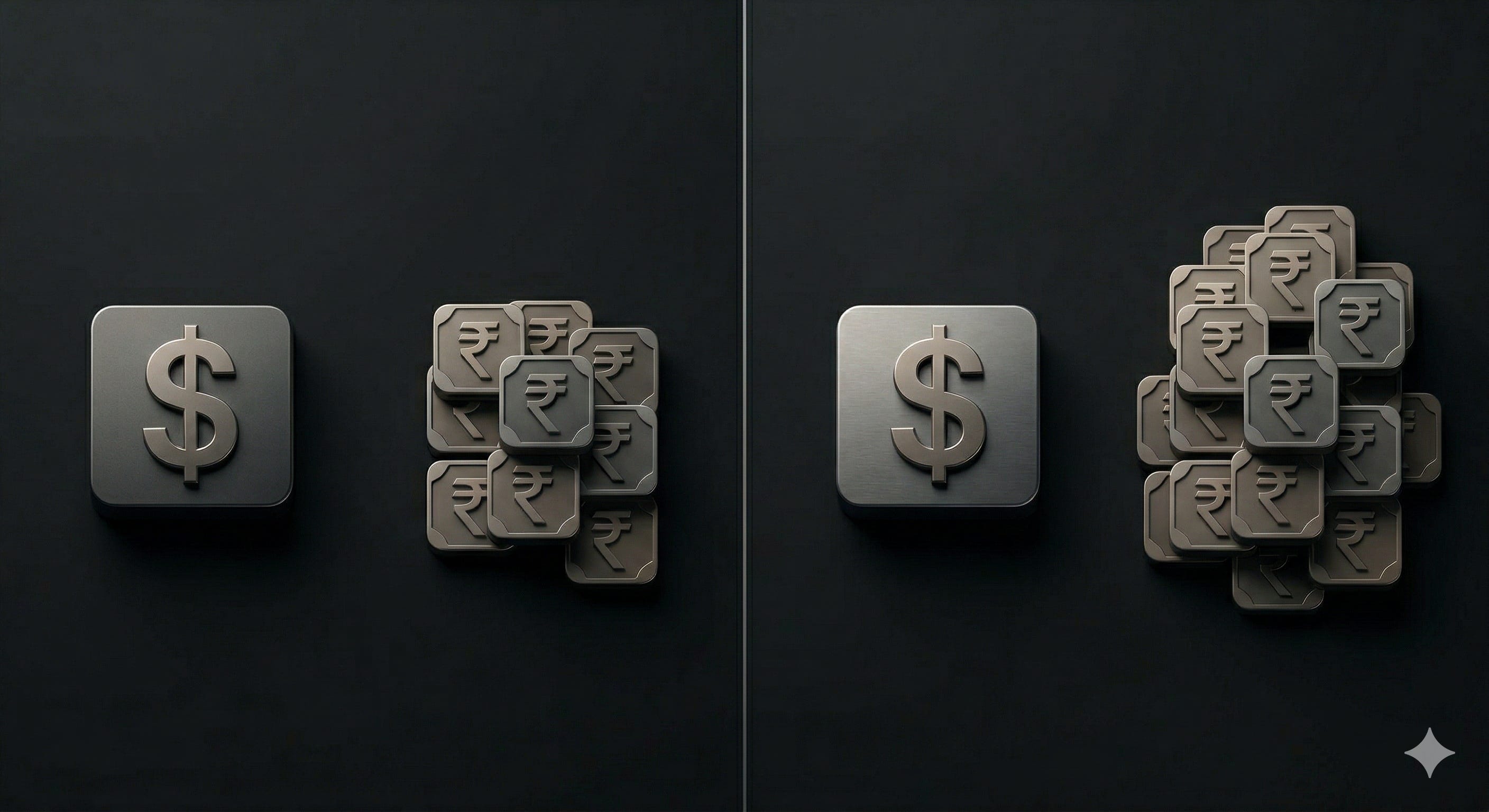
If the number goes UP
Example: ₹80 → ₹94 per dollar
You now need more rupees to buy the same 1 dollar
This means:
Rupee has weakened
Dollar has strengthened
If the number goes DOWN
Example: ₹94 → ₹80 per dollar
You now need fewer rupees to buy the same 1 dollar
This means:
Rupee has strengthened
Dollar has weakened
Same price. Two ways to describe it.
When one strengthens, the other weakens.
And like every price, it comes down to one thing:
How many people are trying to BUY dollars vs how many are willing to SELL them
That’s it.
Everything else builds on this.
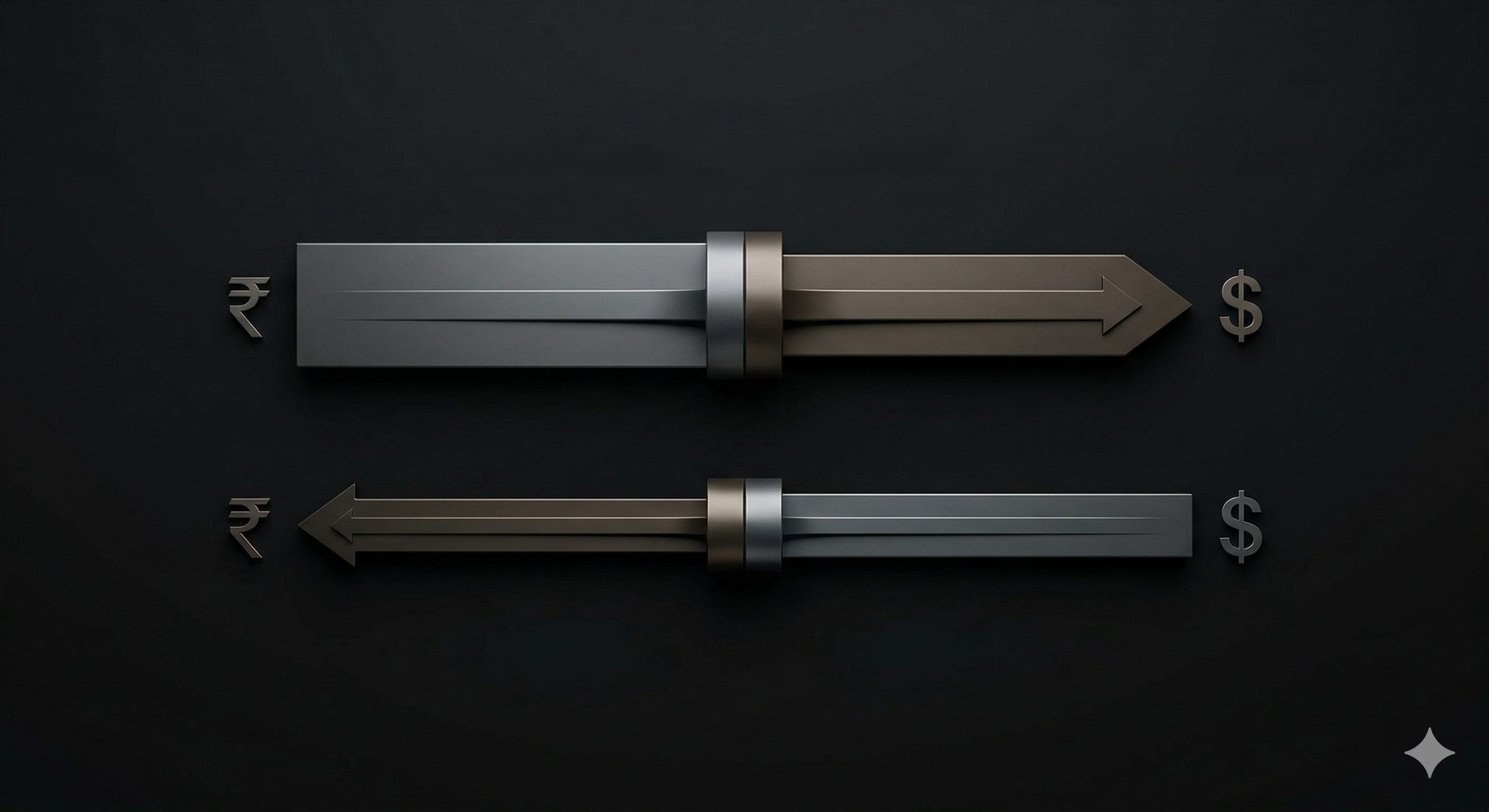
The visible layer: What actually happens every day
Every day, two types of transactions happen in India.
1. People BUYING dollars
These are people who have rupees but need dollars.
They:
Sell rupees → Buy dollars

Examples:
Importers (oil, electronics)
Indians traveling abroad
Companies paying for foreign services
Indians investing abroad
This creates demand for dollars.
2. People SELLING dollars
These are people who have dollars but need rupees.
They:
Sell dollars → Buy rupees

Examples:
Exporters earning from abroad
NRIs (non-resident Indians) sending money home
Foreign tourists spending in India
Foreign investors bringing money into India
This creates supply of dollars.
How price gets decided
Now it’s just a market.
More buyers of dollars → Demand ↑ → Dollar price ↑ → Rupee weakens
More sellers of dollars → Supply ↑ → Dollar price ↓ → Rupee strengthens

If supply is greater than demand, the dollar becomes cheaper.
If demand is greater than supply, the dollar becomes expensive.
This is the base layer.
But this isn’t the full story
If only imports and exports mattered, exchange rates would move slowly and predictably.
They don’t.
Because there are deeper forces - all of which still feed back into the same thing:
Demand and supply for dollars
Layer 1: Trade imbalance (the constant pressure)
India consistently:
Buys more from the world than it sells
Which means:
More people are buying dollars (imports)
Fewer people are selling dollars (exports)
Net effect: Demand > Supply
Result: Structural pressure for the rupee to weaken
This is the baseline pressure in the system.
Layer 2: Capital flows (the fast-moving force)
This is investor money.
Capital flows also include forex trading - where investors and traders buy or sell dollars purely based on expectations, often moving prices faster than underlying trade.
When money comes INTO India
Foreign investors: Bring dollars → Sell dollars → Buy rupees
Which means:
Dollar supply ↑
Dollar price ↓
Rupee strengthens
When money goes OUT of India
Foreign investors: Sell rupees → Buy dollars
Which means:
Dollar demand ↑
Dollar price ↑
Rupee weakens
These flows are large and fast.
They often move currencies more than trade.
Layer 3: Interest rates (why money moves)
Money goes where it earns more.
If:
Interest rates in the US rise relative to India
Then:
Global money shifts to the US
Investors buy dollars
From India’s point of view:
Dollar demand ↑
Rupee weakens
Even if nothing changed domestically.
Layer 4: Expectations (the feedback loop)
Currencies don’t just move on reality.
They move on belief.
If people expect:
“The dollar will become more expensive”
Then today:
Importers buy dollars earlier
Investors hedge by buying dollars
These expectations often show up immediately through forex trades, pushing demand into the present.
Demand increases now.
Which causes:
The dollar to actually become more expensive
Future demand gets pulled into the present
Layer 5: Inflation (the slow structural force)
This doesn’t move markets daily.
But over time, it quietly reshapes everything.
If India has higher inflation than the US:
Step 1 - Prices rise faster in India
Indian goods become relatively more expensive compared to global alternatives
Step 2 - Trade adjusts
Exports become less competitive → Dollar supply ↓
Foreign buyers find Indian goods more expensive
They buy less from India
Fewer dollars come into India
Imports remain strong or rise → Dollar demand ↑
India still needs imports (oil, electronics, etc.)
Some imports are essential or still better value
Indians continue (or increase) buying from abroad
Step 3 - Net effect
Demand for dollars ↑
Supply of dollars ↓
Which means:
Dollar price rises
Rupee weakens over time
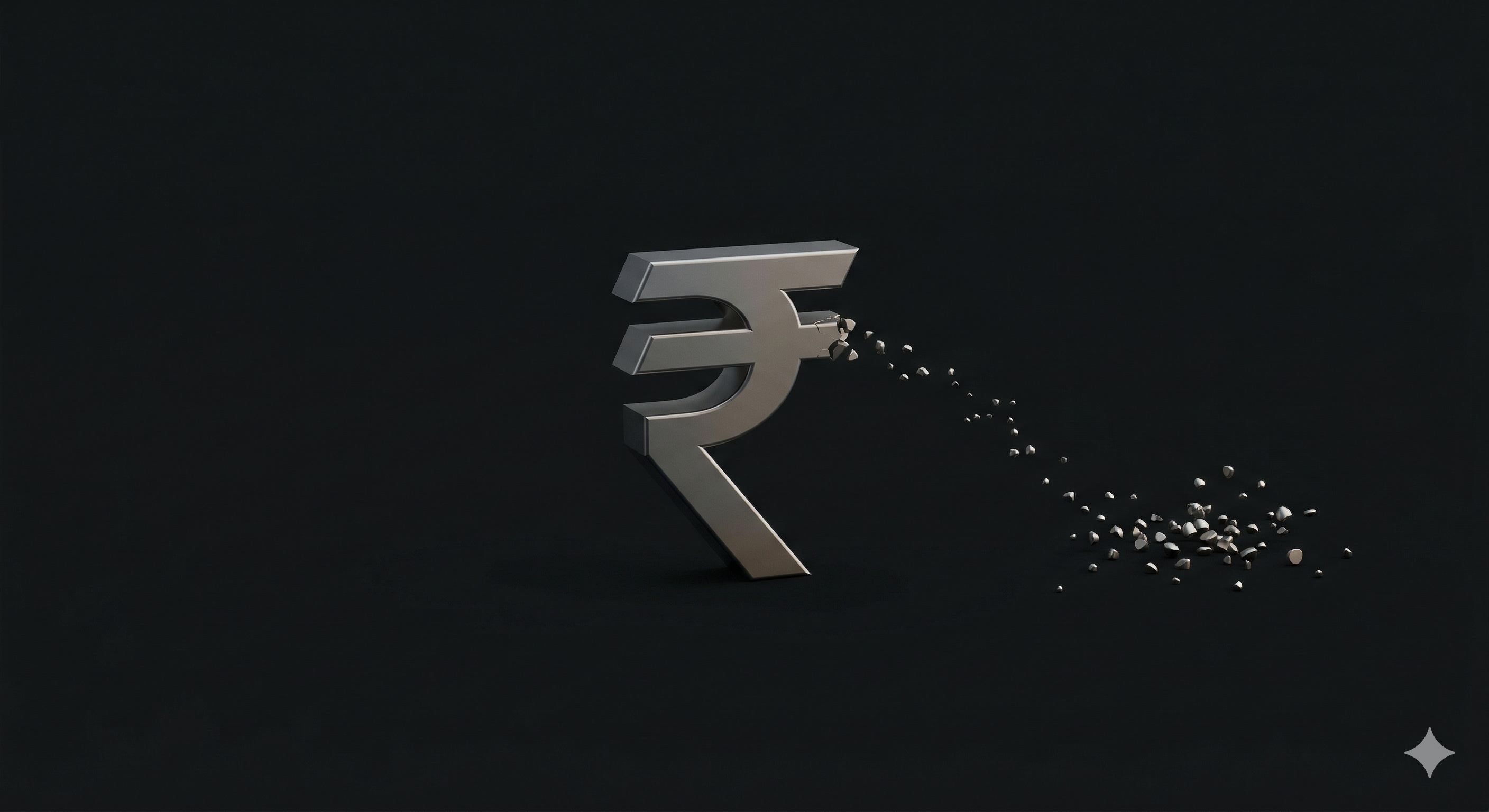
Inflation is not a shock, nor does it act daily
It’s a slow drift, quietly shifting demand and supply over years
Layer 6: Central bank intervention (the stabilizer)
The Reserve Bank of India is not a spectator.
If the rupee weakens too fast
RBI:
Sells dollars → Buys rupees
This means:
Dollar supply ↑
Price stabilizes
If the rupee strengthens too much
RBI:
Buys dollars → Sells rupees
This means:
Dollar demand ↑
Prevents Indian goods from becoming too expensive for foreign buyers
Putting it all together
Every factor - no matter how complex - eventually shows up as one of two things:
More people trying to buy dollars
Or more people trying to sell dollars
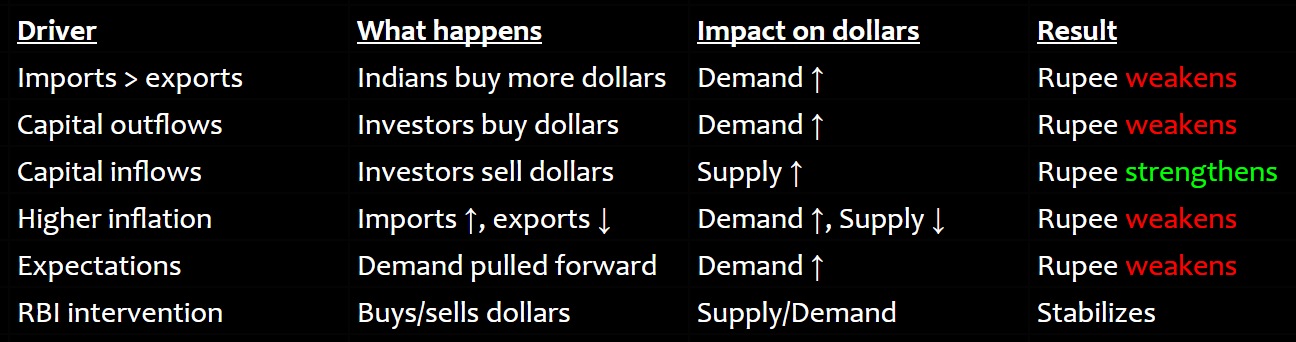
The Zenca mental model
Think of the exchange rate as a pressure system:
Imports → demand ↑ (buy dollars) → constant pressure
Exports & remittances → supply ↑ (sell dollars) → release valve
Capital flows → demand ↑ / supply ↑ (buy or sell dollars) → sudden spikes
Inflation → demand ↑ & supply ↓ (buy more, earn less dollars) → slow leak
Expectations → demand pulled forward (buy dollars early) → amplifier
Central bank → supply ↑ / demand ↑ (sell or buy dollars) → pressure regulator
If pressure keeps building:
The system resets at a higher dollar price

The deeper truth
There is no “correct” dollar price.
₹80 is not “right”
₹94 is not “wrong”
The exchange rate is simply:
The point where all current and expected demand for dollars meets supply
One line to take away
The dollar doesn’t become expensive randomly.
It becomes expensive when more people - today and in expectation - need it than are willing to supply it.
Disclaimer
This is educational content, not financial, investment, tax, or legal advice.
Zenca shares perspectives and frameworks to help you think clearly - your decisions are your own.
Please think independently and do your own research.
I write to improve how we think about money.
If this helped you think more clearly about money, you can subscribe to Zenca to receive future essays directly.
Every subscription is a vote for thinking more clearly about money.
And if this resonated, take a few seconds to share it — it might change how someone else thinks about money too.