

You Only Notice Money When It’s Already Too Late
Bull markets reward attention. Bear markets demand it.

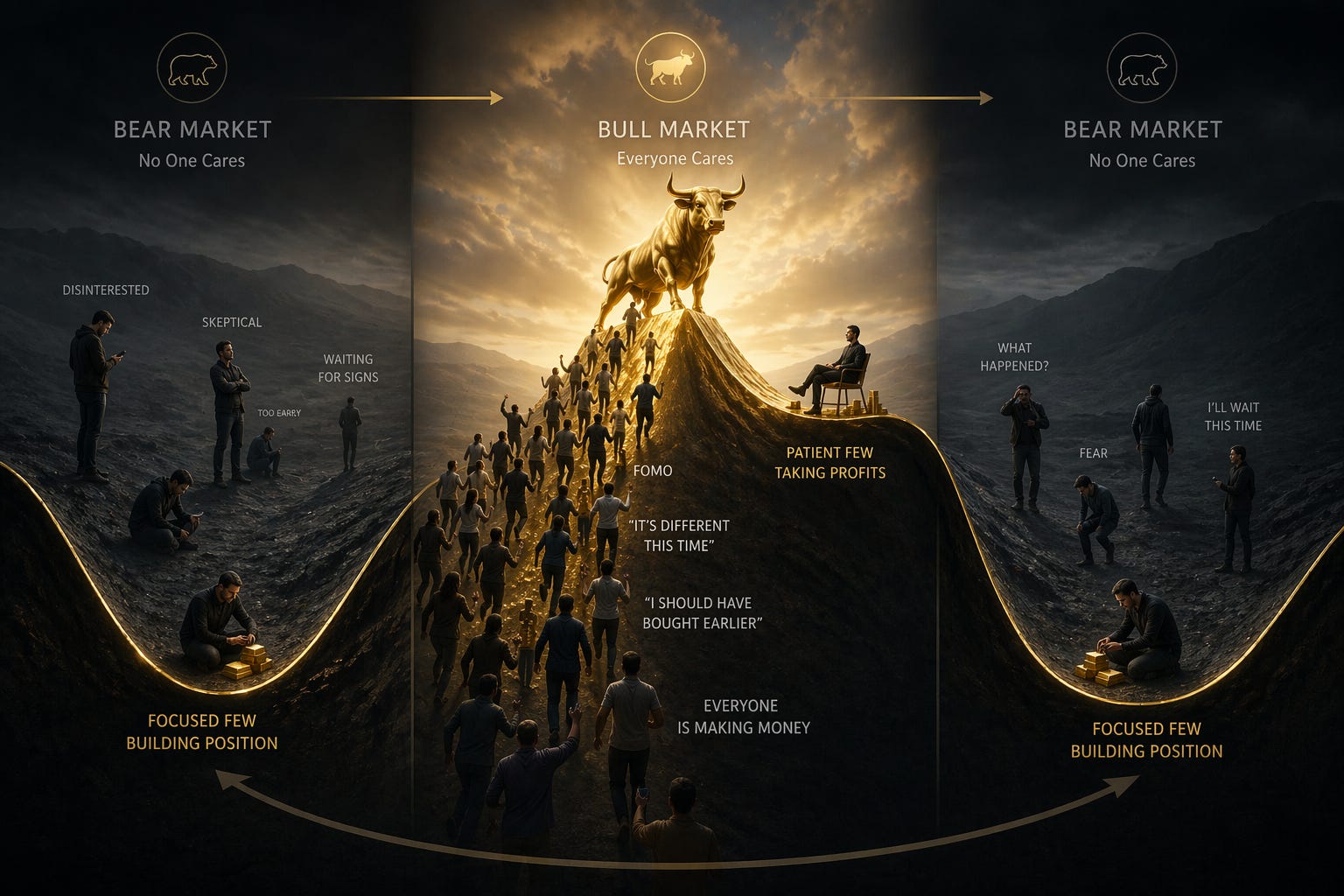
Most people only start paying attention to money when things are going up.
When markets are rising
When prices are making headlines
When everyone around them is talking about it
That’s when curiosity kicks in.
That’s when questions begin.
That’s when action feels urgent.
But by then:
The most important decisions have already been made.
The part no one sees
Every cycle has two phases.
But most people only experience one.
The visible phase - Bull markets
This is when:
Prices go up
Narratives feel obvious
Participation increases
It feels like:
Opportunity is everywhere
Money is easy
Timing is intuitive
But this phase is not where wealth is created.
It is where it is revealed.
The invisible phase - Bear markets
This is when:
Prices fall or stagnate
Interest disappears
Attention drops
It feels like:
Nothing is happening
There’s no urgency
It can wait
But this phase is where everything important happens.
This is where the Cantillon Effect quietly plays out
Money doesn’t enter the system evenly.
It flows through:
Financial institutions
Large balance sheets
Capital allocators
And it flows before most people are paying attention.
So in bear phases:
Capital gets positioned
Assets get accumulated
Risk gets priced
Not by everyone.
But by those:
Closest to capital
Most attentive
Most prepared
By the time you notice, prices have already moved
When the bull phase begins:
Liquidity expands
Prices start rising
Narratives form
And that’s when most people step in.
But by then:
Entry points are worse
Risk is higher
Upside is lower
So they experience the cycle differently:
Less gain
More volatility
Higher emotional stress
Why this keeps repeating
Because attention is cyclical.
When nothing is happening → we ignore it
When everything is happening → we chase it
And this mismatch creates:
A gap between when decisions should be made
and when they actually are.
Zoom out: your lifetime is just a few cycles
In a 30-40 year earning window:
You don’t get infinite opportunities.
You get:
A handful of equity cycles
A few real estate cycles
A few major liquidity expansions
Maybe 5-6 meaningful ones.
And most people:
Miss the first few
Underestimate the next few
React to the rest
What separates outcomes isn’t intelligence
It’s timing of attention.
Not timing the market.
But timing your focus.
Bear markets are not “bad times”
They are:
Low-noise environments
Decision-making windows
Positioning phases
This is when you decide:
How much capital to allocate
Where to allocate it
What risk you’re willing to take
Slowly.
Deliberately.
Without pressure.
Bull markets are not “decision phases”
They are:
Outcome phases
Feedback loops
Emotional amplifiers
They show you:
What your past decisions led to
Not what you should do now
The uncomfortable truth
Most people want certainty before acting.
But markets reward those who act before certainty appears.
And that is exactly how:
The Cantillon Effect compounds
Inequality widens
Outcomes diverge
The loop
Bear market → low attention
Smart positioning happens quietly
Liquidity expands
Bull market → attention spikes
Late participation
Cycle resets
And then:
→ It happens again
→ And again
→ And again
The takeaway
You don’t build wealth in the phase where it looks obvious.
You build it in the phase where it feels unnecessary.
Because:
By the time it feels important,
it’s already expensive.
Disclaimer
This is educational content, not financial, investment, tax, or legal advice.
Zenca shares perspectives and frameworks to help you think clearly - your decisions are your own.
Please think independently and do your own research.
I write to improve how we think about money.
If this helped you think more clearly about money, you can subscribe to Zenca to receive future essays directly.
Every subscription is a vote for thinking more clearly about money.
And if this resonated, take a few seconds to share it — it might change how someone else thinks about money too.
Where is the bear market anywhere?