

The Leverage Trap - Speed, Survival, Timing & Exit Liquidity
Why smart people take extraordinary risks at exactly the wrong time.

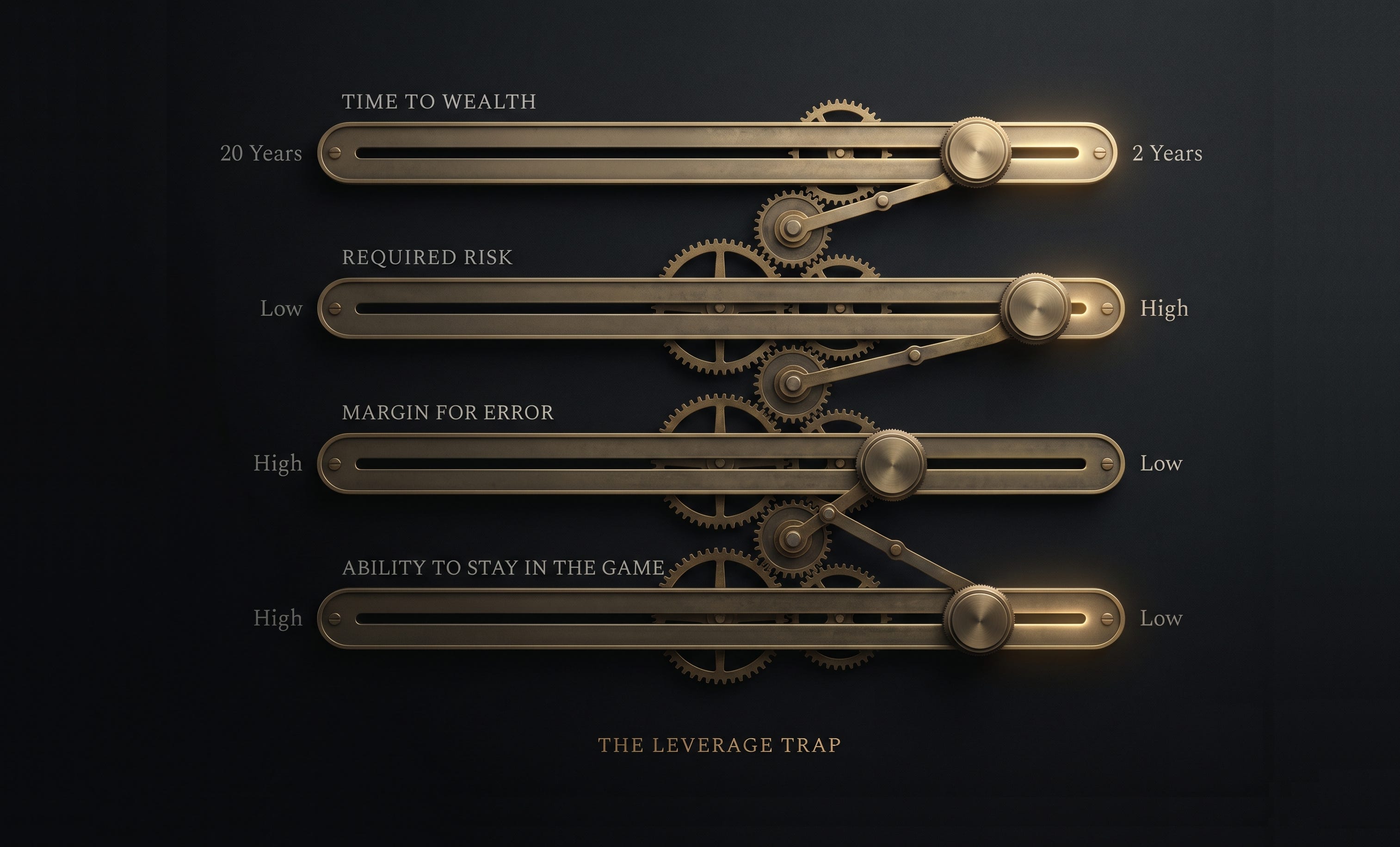
Where the Story Really Begins
Most people think leverage is the problem.
I don’t.
Leverage — using borrowed money to make a larger investment than your own savings would normally allow — is just the final step.
The real story begins much earlier.
It begins with a perfectly human desire: to build wealth faster.
To compress time.
To catch up.
To achieve extraordinary outcomes without having to wait decades.
And that desire changes how people think.
It changes how much risk they are willing to take.
It changes how they behave when markets are rising.
And sometimes, it changes the rules of the game without them even realizing it.
The Four-Part Journey
This four-part series explores why leverage is so tempting, why it is so dangerous, why being right is often not enough, and why people tend to discover leverage at exactly the wrong time.
Because most financial disasters don’t begin with bad intentions.
They begin with perfectly reasonable desires taken one step too far.
Article 1: Why We Always Want Wealth Faster
Most financial mistakes are not caused by greed. They are caused by impatience.
This article explores why humans are naturally drawn to shortcuts, why we consistently trade probability for speed, and why the desire to compress time is often the first step into the leverage trap.
Article 2: The Hidden Cost of Leverage
Most people think leverage amplifies returns.
The deeper truth is that leverage amplifies consequences. It reduces your margin for error, shortens your time horizon, and can force you out of a correct thesis before it has a chance to succeed.
Article 3: Why Being Right Isn’t Enough
Investing is not a prediction game.
It’s a survival game.
You can correctly identify an extraordinary opportunity and still fail if you cannot survive the path between today and being proven right. This article explores why volatility is the admission fee for long-term returns — and why survival is one of the most underrated skills in investing.
Article 4: Retail Is Usually The Last Buyer
Why does leverage become most attractive when it is often most dangerous?
This article explores how social proof, rising prices, and the fear of missing out drive people toward leverage near the later stages of a cycle — and why feeling late has probably destroyed more wealth than being wrong.
The Central Lesson
Wealth is rarely destroyed because people lack intelligence.
More often, it is destroyed because people underestimate time, overestimate certainty, and try to force outcomes that can only be earned patiently.
The greatest investors are not always the people who make the boldest bets.
They are often the people who survive long enough for good decisions to compound.
And that’s a very different game from the one leverage promises.
Disclaimer
This is educational content, not financial, investment, tax, or legal advice.
Zenca shares perspectives and frameworks to help you think clearly - your decisions are your own.
Please think independently and do your own research.
I write to improve how we think about money.
If this helped you think more clearly about money, you can subscribe to Zenca to receive future essays directly.
Subscriptions are the only true ongoing signal I get that this work is valuable to others.
And if this resonated, take a few seconds to share it — it might change how someone else thinks about money too.